Texas-Mexico Border Transportation Master Plan update
International trade and border planning
About the plan
The Texas-Mexico Border Transportation Master Plan is a binational, comprehensive, multimodal long-range transportation plan. It identifies issues, needs, challenges, opportunities, and strategies for moving people and goods efficiently and safely across the Texas-Mexico border, the border region, and beyond. TxDOT, in collaboration with the Border Trade Advisory Committee, binational federal, state, regional, and private sector stakeholders are in the process of updating the Texas-Mexico Border Transportation Master Plan, (English, Spanish) adopted in 2021 by the Texas Transportation Commission. As the population and economy in the Texas-Mexico border region continue to grow many new challenges have emerged. Improving the existing multimodal infrastructure is critical to enhancing the quality of life for residents of the border region.
Why the Texas-Mexico border matters
Transportation infrastructure in Texas plays a vital role in facilitating the nation’s trade with Mexico. Given the current and projected travel demand, improving the capacity and operations of the existing multimodal infrastructure is critical to alleviate traffic congestion, facilitate international trade, e-commerce, reduce environmental impacts, and enhancing the state’s economic competitiveness in trade and beyond.
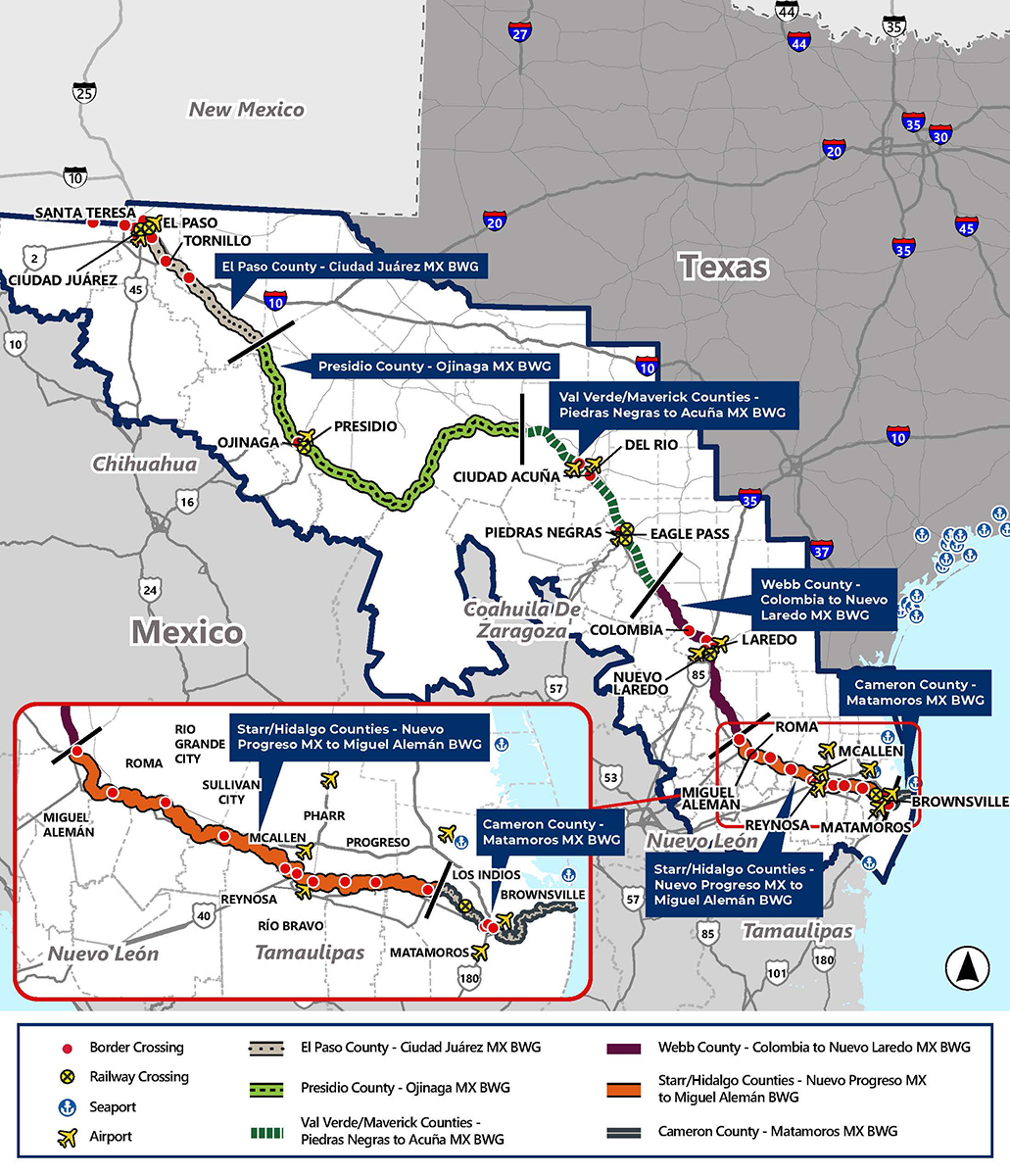
Study area
Stakeholder and public engagement
Input from U.S. and Mexican stakeholders and the public will be critical to identify needs and opportunities for moving people and goods efficiently and safely through the Texas-Mexico border region and beyond.
Key stakeholders include:
- TxDOT district and division representatives
- U.S. and Mexico federal and state agencies
- U.S. and Mexico City/County leadership
- Chambers of Commerce and Economic Development
- Industry representatives including private owners and associations, bridge owners, customs brokers/logistics, and warehousing companies
- State-wide and local trucking associations
- Representatives from all modes of travel including pedestrian/cyclists, rail, transit, aviation, maritime, and freight.
Binational Working Group meetings
Six Binational Working Groups were developed to provide binational perspectives on trade, mobility and infrastructure.
| Date | BWG | Location |
| 10/07/2025 ; 02/25/2026 | Cameron County – Matamoros BWG | Brownsville, TX |
| 10/08/2025 ; 02/24/2026 | Starr/Hidalgo Counties – Nuevo Progreso to Miguel Alemán BWG | McAllen, TX |
| 10/23/2025 ; 03/03/2026 | Webb County – Colombia to Nuevo Laredo MX BWG | Del Rio, TX |
| 10/22/2025 ; 02/11/2026 | Val Verde/Maverick Counties – Piedras Negras to Acuña NX BWG | Laredo, TX |
| 10/29/2025 ; 02/05/2026 | Presidio County – Ojinaga MX BWG | Presidio, TX |
| 10/28/2025 ; 02/03/2026 | El Paso County – Ciudad Juarez MX | El Paso, TX |
Get involved
The International Trade and Border Planning Branch oversees the long-standing coordination and collaboration between Texas and Mexico partnerships for binational planning, programming, and implementation of policies, programs, and projects to facilitate efficient and safe cross-border movement of people and goods, and to promote Texas’ key role in international trade in the U.S.
Contact us
For more information about international trade and bilateral transportation planning and programs, contact the International Trade and Border Planning Branch at TXDOT_BorderTrade@txdot.gov.