Displaced Left-Turn (DLT)
Innovative Intersections
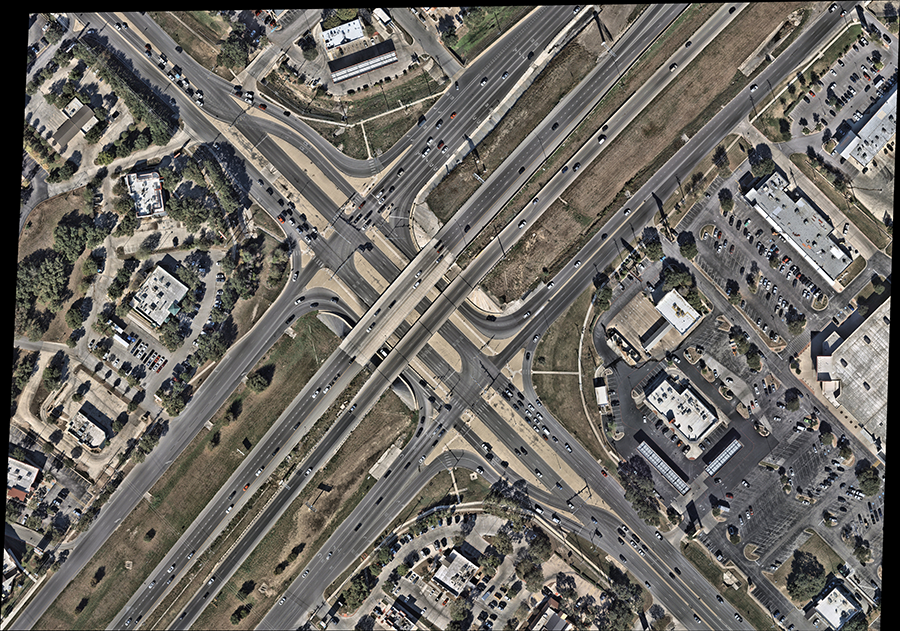
Partial DLT Intersection at Loop 1604 and SH 16 / Bandera Road in San Antonio, TX
Source: Nearmap
What is a DLT

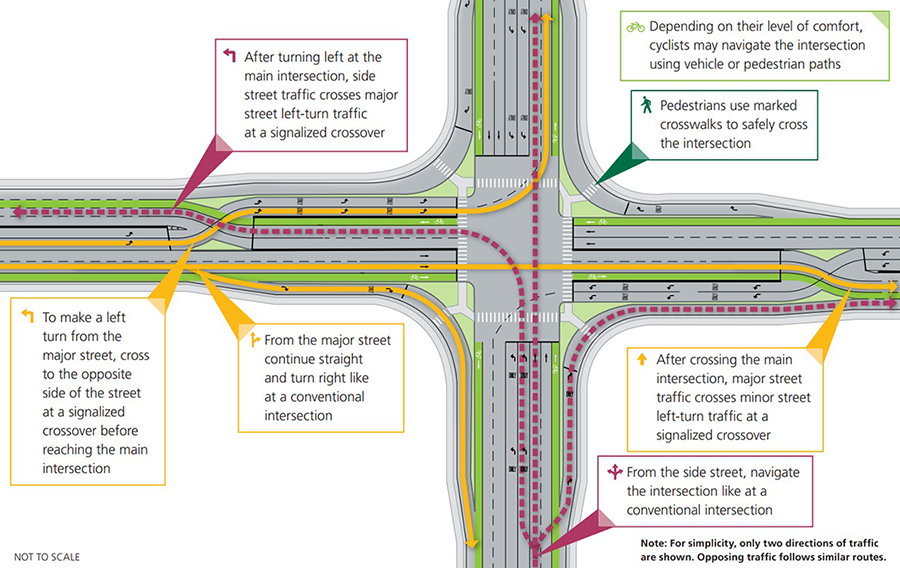
Partial DLT Intersection diagram showing traffic flow and navigation guidance
Source: VDOT, used with permission
Design principles
The DLT is characterized by the following basic principles:

Displaced Lefts
Removal of left-turn phases from the main intersection allows simultaneous left turn and through movements.

Crossovers
Left-turn movements must cross over opposing through lanes of traffic prior to the main intersection.
Design characteristics
Common to all DLTs
Left turns at the main intersection do not conflict with opposing through traffic.
Signalized left-turn crossovers must be coordinated with the main intersection.
Intentional roadside signage and pavement markings to guide left-turn vehicles and avoid wrong-way drivers.
Site dependent
Providing access to parcels near the DLT intersection must be considered.
Can be designed as a full DLT (with left-turning traffic at all arms of the intersection being displaced), or a partial DLT (left-turn crossovers on the main street only).
Facilities such as refuge islands and shared-use paths may be considered.
When to consider a DLT
- Intersection with three or more legs, major corridor with heavy through and left-turning traffic.
- Controlled access and/or little to no driveways near the intersection.
- Limited pedestrians crossing the intersection or where an alternative crossing can accommodate pedestrian needs nearby.
DLT limitations
- Longer crossings and counterintuitive vehicle directions may be more challenging for pedestrians and cyclists.
- Crossovers may result in counterintuitive vehicle directions, increasing the potential for wrong-way drivers.
- A larger intersection footprint is required for displaced lanes, resulting in higher cost and right-of-way needs.
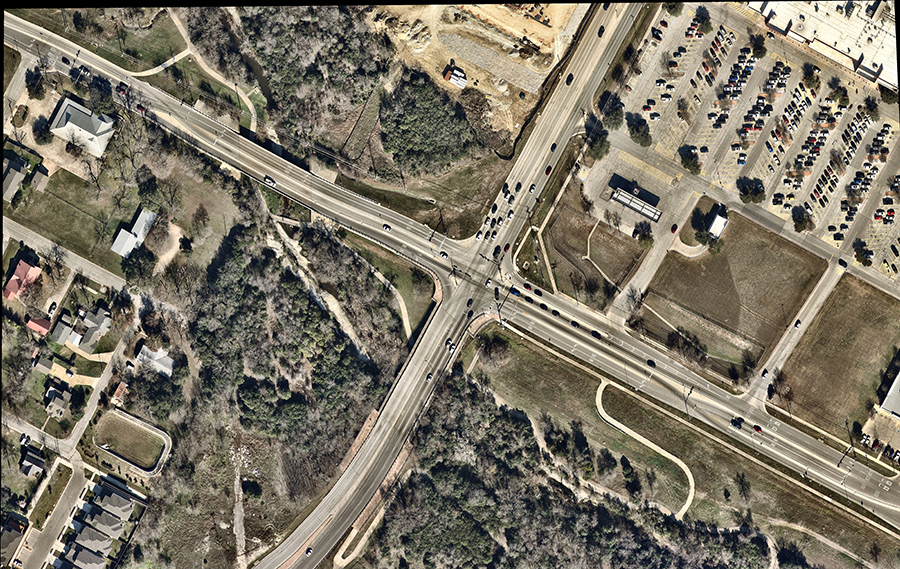
East Pecan Street at FM 685, Pflugerville, TX
Source: Nearmap
Benefits of DLTs
- Reduces and spreads out the number of vehicle conflict points by crossing over left-turning traffic.
- One study showed a 24% reduction in total crashes and a 19% reduction in fatal and injury crashes two years after opening (Source: FHWA-HRT-09-055)
- Reduction in traffic signal phases, reducing overall delay compared to conventional signalized intersections.
- Studies show a 10%-30% increase in vehicle through-put, and a 30%-80% reduction in vehicle delay depending on configuration and traffic flow when compared to a conventional intersection. (Source: FHWA-HRT-09-055)
- Potential to postpone or eliminate the need for future grade-separation intersections due to increased intersection capacity.