Continuous Green-T (CGT)
Innovative Intersections
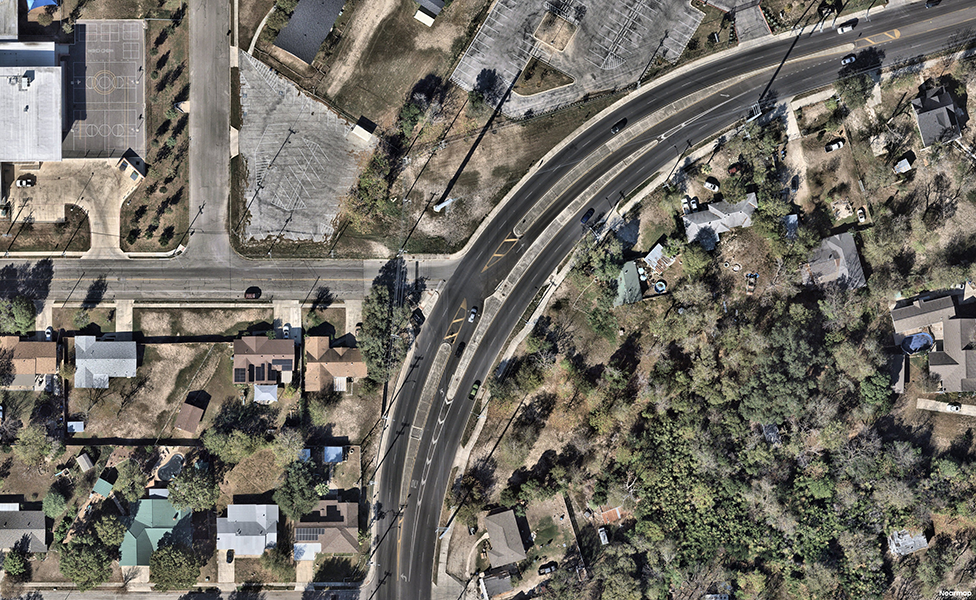
CGT Intersection at Thunder Drive and Callaghan Road in San Antonio, Texas
Source: Nearmap
What is a CGT

A Continuous Green-T (CGT), also known as a High-T, is a three-leg innovative intersection. This configuration enables uninterrupted traffic flow on one side of the major roadway while accommodating left turns on to and off the minor road. CGTs may be either signalized or unsignalized.
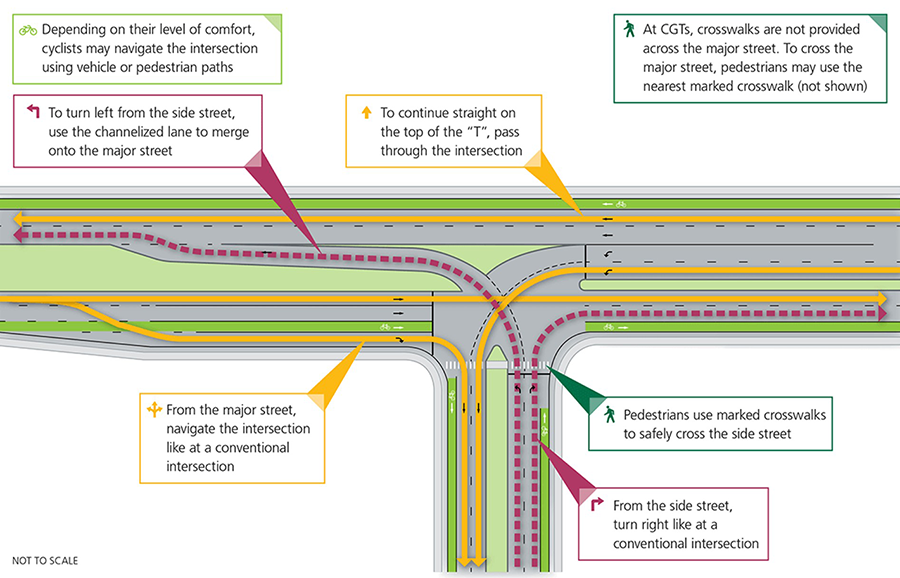
Continuous Green-T Diagram with navigation guidance
Source: VDOT, used with permission
Design principles
The CGT is characterized by the following basic principles:

Continuous Flow
Through movements are uninterrupted on the far side of the major roadway.

Separated Lefts
Left-turn lane(s) are provided on the major roadway, and an acceleration/merge lane is provided to receive lefts from the minor roadway.

T -Intersection
CGTs are designed to be used at T-intersections.
Design characteristics
Common to all CGTs
Pedestrian crossings along the major roadway are typically discouraged.
Raised medians are recommended to help channelize drivers and discourage incorrect movements.
Left-turning vehicles from the minor roadway require acceleration lanes to merge safely with the major roadway.
Site dependent
Depending on the capacity analysis, CGTs may be signalized or unsignalized.
Continuous major roadway through-lanes may feature green through-arrow signalization.
Can cause driveway access limitations.
When to consider a CGT
- Intersections with three legs.
- Heavy through traffic volumes on the major street.
- Moderate to low left-turn traffic volumes on the side street.
- No driveways along the free-flowing side of the major street.
- Pedestrian crossings across the major street are not required, or with an alternative pedestrian crossing location nearby.
CGT limitations
- Restricts pedestrian crossings along the major street.
- Increased intersection length for the receiving acceleration lane on the major street.
- Increased cross-sectional width for the speed change lanes and the center median.
- Specifically applies to three-legged intersections only.
- May not be feasible in close proximity to adjacent intersections.
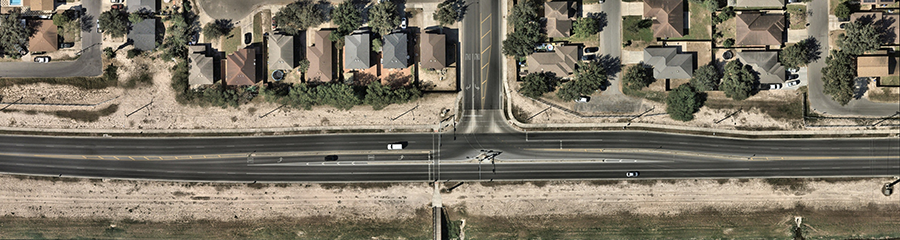
CGT Intersection at Bicentennial Boulevard and Lark Boulevard in McAllen, Texas
Source: Nearmap
Benefits of CGTs
- Reduces the number of left-turn and crossing conflict points, resulting in a reduction of angle, injury, and total crashes.
- Implementation of CGTs cumulatively reduced angle crashes at the treated intersections by 96.8 percent, injury crashes by 70 percent, and total crashes by 60 percent (FHWASA09016)
- Reduce delays at high-volume intersections by ~10%. (Litsas, S. and Rakha, H.)
- Free flow movement simplifies traffic signal phasing, reducing overall delay.
- The far side of the major street can operate uninterrupted, improving overall corridor travel times.
- Studies have shown that continuous green-T intersections are a cost-effective alternative to the traditional signalized T intersection. (FHWA-HRT-16-036)
Educational materials
Videos
Additional resources
- FHWA Continuous Green-T Intersections - Safety Study
- FHWA Safety Evaluation of Continuous Green-T Intersections
- Guidance for TxDOT Innovative Intersections (Research Report 0-7036)
- TxDOT Roadway Design Manual - Chapter 14 (Continuous Green-T Intersection)
- Virgina DOT Continuous Green-T Information Page