UTP project selection
Developing the UTP

To objectively evaluate and recommend projects for incorporating in the UTP, TxDOT quantifies each candidate project’s benefits to the Texas highway system using data-driven criteria.
Project selection and development
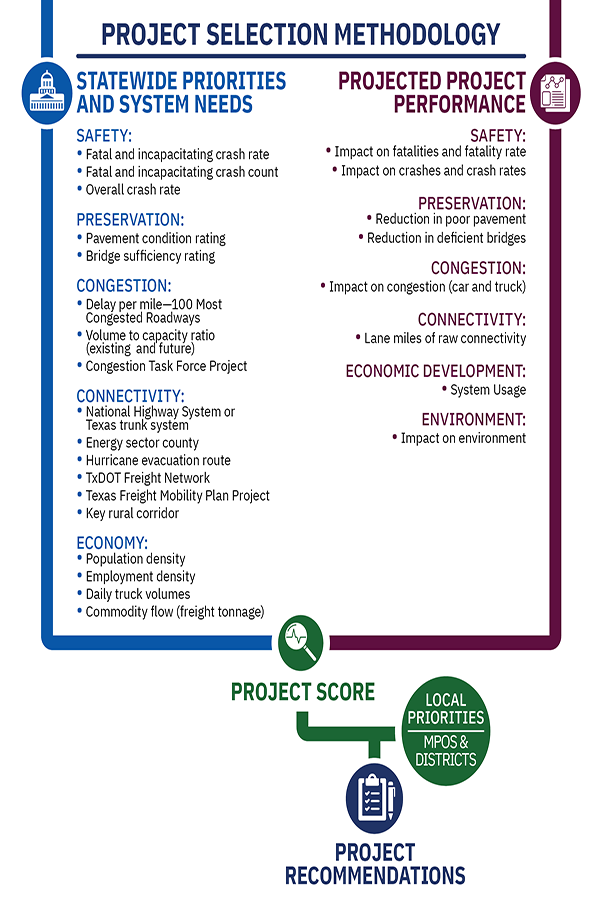
Scoring and prioritizing projects
Project selection starts locally with districts and MPOs working collaboratively with stakeholders to identify projects based on their regional needs. The districts and MPOs are responsible for project prioritization based on those same regional and statewide needs.
TxDOT provides its districts and partnering MPOs with a software application to rank candidate projects against each other based on measures of safety, pavement and bridge preservation, congestion mitigation, connectivity, economic development and environmental impact.
The scores assigned by the software depend on the group of projects with which it is compared. This method allows TxDOT and partnering MPOs to rank candidates against each other within a dynamic portfolio of projects but does not assign a single, standard score on a project.
TxDOT and its partners also consider other factors when making final decisions, including project costs, scheduling concerns and public input.
To be considered for funding in Category 4 Rural and Category 12, TxDOT districts must submit high-priority candidate projects identified through the local scoring and prioritization process.
TxDOT’s TPP Division scores and prioritizes the projects to assist the Texas Transportation Commission with the evaluation of these candidate projects.
- Each candidate project is evaluated based on its alignment with current statewide priorities and transportation system needs. Scoring criteria include safety (crash data), preservation (pavement and bridge conditions), congestion (traffic metrics), connectivity (priority statewide corridors) and the economy (local population, employment and freight volumes).
- In addition to the needs analysis, a software application is then used to assess projected performance impacts of each project’s proposed roadway improvements.
- Each project receives a composite project score based on transportation system needs and projected performance scores.
- The Texas Transportation Commission then evaluates these numbers alongside the prioritized ranking of projects provided by each district and MPO. This allows the Texas Transportation Commission to consider local priorities and regional equity along with data-driven scores.