Routine Airport Maintenance Program (RAMP)
The sponsor's guide to RAMP
The Texas Department of Transportation (TxDOT) Aviation (AVN) Division administers the Routine Airport Maintenance Program (RAMP) program, which is a cost-share program that provides grants to eligible airports in Texas, for maintenance to eligible airside and landside airport asset/infrastructure needs. RAMP funds come out of the state’s fund for capital construction. Funds are available per fiscal year, with Texas Transportation Commission approval. TxDOT’s fiscal year begins on September 1st and ends on August 31st of the following year. The grant amount is determined on an annual basis, based on available funding. In addition, the cost-share percentage is determined annually, as well.
There is always a cost share for the local government, which is stated in the associated fiscal year RAMP grant. The RAMP grant also contains grant assurances, which must be adhered to, to ensure reimbursement opportunities for eligible items. The grants are executed through the AVN eGrants online portal.
The primary focus of RAMP funds is on safety, along with preserving the capital assets. Eligibility is determined by TxDOT AVN.
While there is no specific “RAMP statute,” the program exists within the broader framework of state laws and regulations governing transportation and aviation in Texas, such as Texas Transportation Code and local ordinances, which provide the legal authority for airport operations and maintenance.
RAMP Grants are forwarded to each airport, prior to the end of the current fiscal year, or as soon as possible, thereafter. Airports are encouraged to take steps to partially execute the grant, based on the needs of the airport. A RAMP grant is specific to one airport. Grant funds cannot be co-mingled between multiple airports.
Once partially executed, the grant should be uploaded into TxDOT’s eGrants system for review and full execution. Work or purchases for the new fiscal year may not begin until the RAMP grant has been fully executed. A grant is considered fully executed only when all required signatures—both the sponsor’s and TxDOT AVN’s—have been completed.
Grant funds expire at the end of each state fiscal year. A reminder will be sent out by the AVN RAMP Coordinator in May (approximately), to remind everyone about the upcoming RAMP grant expiration in August and determine if any Grants may be closed or if the airport is expecting additional expenses to incur between June – August. This helps the AVN Division manage the RAMP Grant budget.
Once the RAMP grant has been fully executed, requests for reimbursement (RFR) may be submitted through the eGrants portal for any eligible and paid expense incurred after the RAMP grant execution date. Each RFR must include a completed detailed Summary of Expenses form, and all required supporting documentation, such as invoices and proof of payment. To avoid delays or returned requests, please ensure that all invoices reflect eligible goods or services that were purchased or performed after the grant execution date and prior to the grant fiscal year end. TxDOT AVN may request additional documentation or photographs for review before approving payment. If you have exhibits or photographs that would help in the review process, you may include these items with your reimbursement request submission.
RAMP commonly covers lower cost airside and landside maintenance activities; however, certain small capital improvement projects, such as airport entrance roads or rotating beacon replacements, may be eligible for reimbursement with TxDOT AVN prior written approval. Since small capital improvement projects may go beyond routine maintenance and can involve new or expanded work, these projects require TxDOT AVN’s review, approval, and guidance before any work begins. As a general rule, if your small capital improvement project is something that TxDOT AVN would include and pay for in a regular CIP Grant Funding Project, it may be considered eligible for reimbursement. Additionally, the Sponsor will certify that the airport’s airside needs have been met. The Small Capital Improvement Project Approval Request Form must be completed and submitted to TxDOT AVN for review, discussion, and approval consideration. As a reminder, work performed prior to TxDOT AVN’s review and approval may be considered ineligible for reimbursement.
Sponsors may issue their own contracts for services included in the RAMP grant. If the Sponsor elects to perform the work using airport/sponsor staff, only the cost of materials is eligible for reimbursement—labor performed by Sponsor’s personnel is not reimbursable. Sponsors may also contract their local TxDOT district to perform certain services—such as fog or pavement sealing and herbicide application, if the local district conducts the type of work being requested and the district agrees to complete the work. The district can provide a cost estimate for the requested work. The RAMP grant must be amended to include the added work, and the Sponsor’s local match of the estimated cost is required before any work can begin. For assistance, contact your TxDOT AVN RAMP Coordinator. TxDOT will not participate in contracts for any ineligible items—such as mowing—or for costs that are unreasonable for the type of service.
Work outlined in the Grant’s Scope of Services must be completed within the state fiscal year (September 1–August 31). Work performed or costs incurred before the RAMP grant execution date are not eligible for reimbursement.
- Item and service eligibility can be broken down into four categories:
- Eligible Airside Maintenance Needs
- Eligible After Airside Maintenance Needs are Met
- Eligible Small Capital Improvement Projects
- Ineligible
The following offers guidance on eligibility within these categories. The items listed below are eligible for RAMP Grant reimbursement. Please work to address your airside maintenance needs first, followed by non-airside items and small capital improvement project consideration. Please feel free to reach out if you have any questions or concerns.
Eligible RAMP reimbursement items are items that focus on safety and the preservation of capital assets. RAMP does not include any beautification or operational considerations.
Airside Maintenance Needs
- Pavement crack sealing/Pavement Slurry Seal/Fog Seal/Rejuvenator
- Pavement markings
- Drainage maintenance
- Airfield FOD sweeping
- Tree trimming and obstacle clearing for safety issues such as runway obstruction.
- Herbicide on airside pavement and perimiter fencing
- Pesticide around airside electrical only
- Replacement bulbs/lamps for airside lighting fixtures and approach aids
- Repair and maintenance for beacon, lighting, approach, and navigational aids
- Eligible air traffic and operations equipment, installation, and associated subscription costs for airport or commercially operated flight tracking system data (in accordance with requirements established in FAA AC 150/5000-17 Critical Aircraft and Regular Use Determination)
- Parts replacement for Automated Weather Observation System (AWOS) not covered under warranty
After Airside Needs Are Met
- Seal coats/chip seal/crack seal for non-airside pavement
- Sponsor owned hangar/terminal building painting and repairs
- Security camera systems excluding monitoring fees
- Game proof or security fencing and gates, electric gate openers
- Game proof and security fencing must be of a reasonable height to protect airport perimeter and discourage trespassers (typically eight feet or higher)
- Access roads for AWOS installations/AWOS NADIN interface monthly charge
- Airport entrance signs
- Repairs/maintenance to airport owned fuel systems/fuel farms, including replacement of tanks of same size and in same footprint. Software and software upgrades are not eligible for reimbursement unless required for the operation of the fuel system, which would fall under “repair of fuel system.”
- Professional Services for preparation of Storm Water Pollution Prevention, Spill Prevention Control & Countermeasure Plans, and maintenance/update of these plans
- Airfield FOD sweeper
- HVAC repairs in terminal building and/or control tower only
- QT Pod/AWOS agreement renewals
Small Capital Improvement Projects Overview
The project must begin and be completed in the same grant FY, unless a prior written exception has been granted by the AVN Division.
- Stand-alone Drainage Study: A copy of the completed drainage study must be provided to TxDOT Aviation prior to reimbursement.
- Design and construct new concrete/asphalt public auto parking areas.
- Design and construct, along with repairs to the Hangar Access Taxiway (HAT).
- Design and construct new entrance roads and hangar access roads.
- Design and construction of aircraft wash racks as indicated by SWPPP.
- Design and construct expansion of apron areas or new apron areas.
- Design and construct runway lighting system extensions.
- Design and construct drainage improvements.
- Pilot lounge/small general aviation terminal buildings.
- Beacon/tower replacements in the same footprint.
- Preparation of FAA form 7460-1 “Notice of Proposed Construction or Alteration” for RAMP projects.
Guidance and Pre-Approval from TxDOT Aviation is required prior to work/purchases related to Small Capital Improvement Projects. The sponsor will certify that the airport’s airside needs have been met. Submit the Small Capital Improvement Project Approval Request Form to your planner to start the review and approval process. The Planner may require the project to be included in the ALP, may require confirmation that environmental was completed, may require confirmation that a Flight Check will be performed, if applicable, prior to reimbursement.
Any item not listed above may be considered ineligible. Please be sure to review the eligibility list before procuring goods or services, to avoid ineligible reimbursement requests. The following items represent examples of ineligible costs, please note, this is not a comprehensive list:
- Purchase of a courtesy vehicle and/or maintenance/repairs to any vehicle or equipment including (but not limited to):
- Tractors
- Mowers
- Airport Rescue Fire Fighting vehicles (ARFF)
- Purchase of capital equipment/capital expenditures including (but not limited to):
- Aircraft dolly
- Lawn mower
- Sound canons
- Golf carts
- Snow/ice removal equipment
- Furniture
- Striping machines
- Window ac units
- Mobile generators
- Power washers
- Routine operating expenditures including (but not limited to):
- Carpet cleaning
- Monthly utility bills
- Tree trimming and landscaping services for beautification
- Mowing
- Trash collection and recycling services
- Wheeled fire extinguishers
- Pest control and pesticides, unless around airside electrical
- Bidding and advertising
- Oil storage tanks
- Furniture purchases
- Tools
- Office equipment and electronics (computers, monitors, etc.)
- Storage buildings – construct, repair, or purchase.
- Part 139, and other airport regulatory software implementation and subscription costs
- Airport Layout Plan (ALP)
- Force account work by sponsor
- In-vehicle aviation radio
- FAA Flight Checks
- Any work related to damage that is part of an insurance claim process.
- Consumables including (but not limited to):
- Batteries (except for AWOS)
- Air and water filters
- Tools
- Interior light bulbs
- Cleaning supplies
- Replacement monitors/computer equipment for office operations
- Professional Services for any project which was not approved in writing by TxDOT under the RAMP Grant program.
- Design or professional services associated with a CIP project.
- Construction projects or design work exceeding the FY grant duration.
- Architectural services
- Any project which is not 100% for public use.
- Work performed or purchases made prior to the grant being fully executed.
- A grant is considered fully executed when signed by all parties.
- The date of the last signature is considered the execution date.
- Any invoice which has goods/services completed outside of the executed RAMP Grant year
We are here to help; our goal is to assist municipalities in maintaining and preserving their airfield and airport facilities. Airside Safety and Airside maintenance and improvements should always take precedence before seeking assistance with landside maintenance and improvements. The RAMP Grant Summary of Expenditures should be detailed enough to minimize follow-up questions. Remember the items and services mentioned above are not exhaustive so if you have any questions about item eligibility, please feel free to reach out and contact your TxDOT RAMP Coordinator or regional Planner. The focus should be on safety and preserving capital assets.
For more information contact the TxDOT Aviation Division at:
Phone: 1-800-687-4568 (68-PILOT)
The district RAMP Coordinator's guide to RAMP
Texas’s vast geography and the diverse characteristics of each TxDOT district—ranging from population density and metropolitan activity to climate and terrain—naturally result in varying levels of participation in the Routine Airport Maintenance Program (RAMP). This guidebook is intended to introduce new RAMP Coordinators to the program and support them in overseeing district‑level airport maintenance activities and participation across the state.
While some TxDOT districts regularly collaborate with airports on pavement maintenance and other airside projects, others engage more selectively. Across districts, the most consistently provided service is herbicide application. In some cases, airport sponsors elect to purchase herbicide products for use by their licensed applicators or contract privately for the full scope of work. These examples illustrate the flexibility of RAMP participation and underscore the role of this guidebook as a practical manual—particularly for coordinators working at a foundational or “grassroots” level.
Many airport sponsors are highly experienced in grant and program management. These sponsors may use district services on a limited basis, choosing instead to allocate a sizable portion of their RAMP grant funds toward independently contracted projects or direct purchases that best meet their operational needs.
One of the most critical functions of a RAMP Coordinator is serving as TxDOT’s on‑site presence during urgent or unplanned situations. When an airport sponsor contacts the Aviation Division regarding critical issues such as a significant airside pavement failure—TxDOT area maintenance offices often function as first responders by providing site observations, photographs, and preliminary assessments. Frequently, the district RAMP Coordinator is the airport’s initial point of contact due to established working relationships and familiarity with local conditions.
District participation is a key contributor to the Routine Airport Maintenance Program’s continued success and statewide popularity. Your involvement as a RAMP Coordinator is highly valued by the Aviation Division. For new coordinators, this guidebook is intended to serve as a solid starting point. Experienced colleagues within your district and across the state are excellent resources, and the Aviation Division remains available to provide guidance and support whenever needed.
Airport maintenance presents ongoing challenges for many airports across Texas. In numerous cases, local communities lack the resources to conduct essential services, and securing funding remains a consistent obstacle. The Routine Airport Maintenance Program (RAMP) was created as a cost‑sharing program between TxDOT and general aviation airports in Texas. RAMP comes out of the state’s fund for capital construction.
In 1996, the Texas Department of Transportation (TxDOT) Aviation Division began RAMP with five pilot TxDOT districts. The program was designed to assist communities with maintenance programs by offering state financial assistance. State funds matched local funds on a 50/50 basis with a maximum of $10,000 in state funds per airport, per year. Airports were allowed to use the services of TxDOT districts and their contracts for crack sealing, herbicide application, striping, marking, and other similar services.
The initial program was a success and has now expanded to include all districts and allow all publicly owned/operated airports, including non‑hub primary commercial service airports in the Texas Airport System Plan (TASP), to participate at the current program maximum of $100,000 in state funds per airport, per year. Services have expanded to include other items such as airport lighting and maintenance, airport entrance road construction, pilot lounges, environmental compliance, and automated weather observing system (AWOS) maintenance.
The program has grown from supporting approximately thirty airports with a total of $250,000 in expenditures to over two hundred participating airports with a budget of $10 million in state grant funding. Growth and expansion have enabled many airports to maintain required operational standards and remain compliant with both state and federal regulations.
RAMP is currently a 90/10 cost‑share program in which TxDOT will fund up to $100,000 total per fiscal year, per eligible airport for eligible items (see #appendix-b-ramp-item-eligibility). The sponsor (local government) match is 10% of the actual eligible costs plus any amount above $111,111.11.
A sponsor can be a city, a county, or entities such as river authorities, colleges, navigation districts, and similar public entities.
All RAMP grant work issued in a fiscal year must be completed in the same fiscal year. TxDOT’s fiscal year begins September 1 and ends August 31 of the following year. For example, Fiscal Year 2026 began September 1, 2025, and ends on August 31, 2026.
A grant must be fully executed (signed by all parties) before any work is performed. Until a sponsor is certain the RAMP grant has been executed, they should not perform any work they intend to submit for reimbursement.
The use of sponsor workforce (force account labor), i.e., municipal or county employees performing work at the airport—is not eligible for RAMP funding. However, the materials used by these forces are typically eligible for RAMP reimbursement. An outside contractor or vendor may be used to perform RAMP grant work.
Airside improvements are always the priority before assistance with landside maintenance and improvements. For example, a pilot lounge, although generally eligible, would be ineligible if the runway is inoperable.
To participate in RAMP, the sponsor navigates to eGrants, selects an execution option, and submits a partially executed grant to TxDOT. There is no formal request process, and a specific maintenance issue does not need to exist to qualify for a RAMP grant. Once the grant is fully executed (signed by all parties), the sponsor has until end of day on August 31 of that fiscal year to complete work and/or receive purchases.
Although work must be completed by August 31, reimbursement requests may be submitted as late as November 30 of the calendar year in which the fiscal year ends.
Before contracting work to be submitted for reimbursement through RAMP funding, the airport sponsor should ensure the following:
- Schedule: Enough time remains in the fiscal year for the work to be completed.
- Funding: Sufficient matching funds are available before starting work (the sponsor must pay 100% of invoices before they can receive 90% reimbursement from TxDOT for eligible costs).
Every TxDOT district assigns a RAMP Coordinator responsible for providing RAMP assistance and guidance to airports in their district. RAMP Coordinators should:
- Be familiar with the airports in their district.
- Know who your AVN airport planner is and introduce yourself to your AVN planner.
- Be knowledgeable about item and work eligibility.
- Know when to refer a sponsor to the Aviation Division (e.g., for small capital projects, scope clarifications, or policy questions).
Given frequent turnover in key city, county, and airport roles, some individuals may be unfamiliar with the RAMP program. Establishing a strong partnership among the Aviation Division RAMP Coordinator, the District RAMP Coordinators, and airport officials is essential to ongoing RAMP success.
The RAMP grant process is designed to be minimally burdensome for TxDOT. Airports may purchase items or have work performed, pay for that work, and then request reimbursement from TxDOT with minimal involvement. (See #workforce-requests for TxDOT‑performed work.)
The Texas Airport Directory is a valuable resource for RAMP Coordinators. Each listing contains information such as an airport diagram, manager contact information, attendance schedule, and fixed‑base operator (FBO) details. The directory is available via website (see #appendix-a-resources) and in hard copy (the website will have the most up‑to‑date information).
Another resource for RAMP Coordinators is AirNav.com, which publishes aeronautical and airport information released by the FAA, such as runway length, traffic patterns, frequencies, operations, facilities and services, chart location, navigational coordinates, radio aids, ownership information, pilot feedback, and other pertinent data.
Pavement failures, faded markings, and lighting issues, are some of the most common conditions a RAMP Coordinator may encounter during an airport visit. Although not exhaustive, these represent common needs that RAMP was designed to address.
Small capital improvement projects—such as constructing a new entrance road or expanding an apron area—require pre‑approval and guidance from the Aviation Division. If an airport is inquiring about a small capital improvement project, they should be referred to their TxDOT Aviation Planner. Additional small capital improvement projects are listed in Small Capital Improvement Projects.
Airports may choose to have certain work—such as herbicide application or fog seal application—performed by the TxDOT workforce. The District RAMP Coordinator will need to make sure that the District Maintenance is aware that this is in place. The process is as follows:
- The airport submits the Workforce Request Form (Sections 1 and 2) to the District RAMP Coordinator.
- The District RAMP Coordinator provides an estimate in Section 3 and returns the form to the airport and the Aviation Division (AVN) RAMP Coordinator.
- If the airport chooses to proceed after receiving the estimate, the AVN RAMP Coordinator will amend the grant to include the requested work and collect the airport’s 10% share of the estimated costs.
- Once the amendment is signed and the funds are received by TxDOT, the district may perform the work.
When the TxDOT workforce performs work at an airport, it is important for the district to accurately capture costs in PeopleSoft. This ensures proper accounting, audit readiness, and timely reimbursement.
Materials: The maintenance office that supplies materials for airport work will Express Issue the materials in PeopleSoft. Include a brief reference to RAMP in the comments field; for example, for herbicide application, enter: Herbicide used for RAMP Program. Charges must be applied to the specific project‑related chartfields, as shown below (Project ID and AY will vary):
- Department ID: 420000
- Account: 7611
- AY: [Year work performed] (e.g., 2025)
- Approp: 13024
- Fund: 0006
- PC Bus Unit: 60175
- Project ID/CSJ: 42M2509HILL
- Activity: AVN
- Source: 835
Notes:
- Project ID will always be “42” followed by the CSJ.
- AY will be the appropriation year in which the work was performed.
Labor: Employees who perform work at airports must include the project number in their timesheet chartfield detail. TxDOT workforce costs should not be charged to an overhead account.
Steps in My Time and Leave (PeopleSoft):
- Enter hours as normal.
- Select the Time Details icon.
- Click the Chartfields hyperlink.
- Populate the appropriate project number.
- Click Done.
- Click Done again.
- Click Submit, then Accept and Continue.
Before visiting an airport:
- Coordinate with AVN: Contact the AVN Division Planner to discuss the airport’s needs.
- Schedule with the Airport: Call the airport manager in advance to set an appointment and/or introduce yourself.
- Prepare:
- Review basic airport terminology.
- Review the airport diagram and current operational information.
- Gather necessary items (e.g., camera/phone for documentation, notebook, measuring tools as needed).
- Recruit expertise if needed (pavements, lighting/electrical, drainage).
- Bring appropriate personal protective equipment (PPE).
At airports, safe practices are essential because of the operational environment and potential hazards. Do not enter active aircraft operation areas without the airport manager or an authorized representative who has access, authority, and appropriate communications (e.g., radio) and can escort through secured gates.
More safety information can be found at the Federal Aviation Administration Airport Safety section at:
Do not hesitate to bring additional subject‑matter expertise on airport visits. Maintenance Supervisors, Area Engineers, Directors of Maintenance, Special Crew Supervisors, and Assistant Maintenance Supervisors can contribute knowledge and historical context. Often, these personnel have prior experience working with the airport.
Helpful Aviation Division Contacts
Cassandra Moore, AVN RAMP Coordinator
Linda Gomez, AVN RAMP Payment Reviewer
Michelle Burcham, AVN Grants Section Director
Websites and Resources
Texas Airport Directory Map: https://maps.dot.state.tx.us/TADSMap/
FAA Airport/Facility Directory (Chart Supplement) Advanced Search: https://www.faa.gov/air_traffic/flight_info/aeronav/digital_products/dafd/search/advanced/
AirNav: https://airnav.com/
Overview
Item and service eligibility is organized into four categories:
- Eligible Airside Maintenance Needs
- Eligible After Airside Maintenance Needs Are Met
- Eligible Small Capital Improvement Projects
- Ineligible
RAMP reimbursement focuses on safety and preservation of capital assets. RAMP does not include beautification or routine operational expenses.
If you have questions about a specific item, contact your TxDOT AVN Planner or the AVN RAMP Coordinator.
Eligible Airside Maintenance Needs
- Pavement crack sealing / slurry seal / fog seal / rejuvenator.
- Pavement markings.
- Drainage maintenance.
- Airfield FOD sweeping.
- Tree trimming and obstacle clearing for safety (e.g., runway obstruction).
- Herbicide treatment on airside pavements and perimeter fencing.
- Pesticide treatment around airside electrical only.
- Replacement bulbs/lamps for airside lighting fixtures and approach aids.
- Repair and maintenance for beacon, lighting, approach, and navigational aids.
- Eligible air traffic and operations equipment, installation, and associated subscription costs for airport or commercially operated flight tracking system data (in accordance with requirements established in FAA AC 150/5000-17 Critical Aircraft and Regular Use Determination)
- Parts replacement for Automated Weather Observing System (AWOS) not covered under warranty.
Eligible After Airside Maintenance Needs Are Met
- Seal coats / chip seal / crack seal for non‑airside pavement.
- Sponsor‑owned hangar/terminal building painting and repairs.
- Security camera systems (excluding monitoring fees).
- Game‑proof or security fencing and gates; electric gate openers. (Fencing should be of reasonable height to protect the perimeter and discourage trespassers, typically eight feet or higher.)
- Access roads for AWOS installations / AWOS NADIN interface monthly charge.
- Airport entrance signs.
- Repairs/maintenance to airport‑owned fuel systems/fuel farms, including replacement of tanks of the same size and in the same footprint. (Software and software upgrades are not eligible unless required for operation of the fuel system, which would fall under “repair of fuel system.”)
- Professional services for preparation and maintenance/update of SWPPP and SPCC plans.
- Airfield FOD sweeper.
- HVAC repairs in terminal buildings and/or control towers only.
- QT Pod/AWOS agreement renewals.
Small Capital Improvement Projects
Projects must begin and be completed in the same grant fiscal year unless a prior written exception has been granted by the AVN Division. Pre‑approval is required via the Small Capital Improvement Project Approval Request Form submitted to the TxDOT AVN Planner.
- Stand‑alone Drainage Study (submit completed study to TxDOT Aviation prior to reimbursement).
- Design and construct new public auto parking (concrete/asphalt).
- Design and construct, along with repairs to the Hangar Access Taxiway (HAT).
- Design and construct new entrance roads and hangar access roads.
- Design and construct aircraft wash racks as indicated by SWPPP.
- Design and construct apron expansions or new apron areas.
- Design and construct runway lighting system extensions.
- Design and construct drainage improvements.
- Pilot lounge / small general aviation terminal buildings.
- Beacon/tower replacements in the same footprint.
- Preparation of FAA Form 7460‑1 (Notice of Proposed Construction or Alteration) for RAMP projects.
Note: The Planner may require inclusion in the Airport Layout Plan (ALP), confirmation of environmental compliance, and/or confirmation that a Flight Check will be performed (as applicable) prior to reimbursement.
Ineligible Item Overview
Any item not listed above may be considered ineligible. Sponsors should review this section before procuring goods or services to avoid ineligible reimbursement requests. Examples include (not exhaustive):
- Project Usage: Any RAMP project that is not 100% for public use.
- Vehicles/Equipment (purchase or maintenance/repairs): Courtesy vehicles, tractors, mowers, and ARFF vehicles.
- Capital equipment/expenditures: Aircraft dollies, lawn mowers, sound cannons, golf carts, snow/ice removal equipment, furniture, striping machines, window AC units, mobile generators, power washers, hangars.
- Routine operating expenditures: Carpet cleaning, monthly utility bills, tree trimming and landscaping for beautification, mowing, trash collection and recycling, wheeled fire extinguishers, pest control and pesticides (unless around airside electrical components), bidding and advertising, oil storage tanks, office furniture, tools, office equipment and electronics (computers, monitors, etc.), storage buildings (construct, repair, or purchase), Part 139 and other airport regulatory software implementation and subscription costs, Airport Layout Plan (ALP), force account work by sponsor, in‑vehicle aviation radio, FAA Flight Checks, any work related to damage that is part of an insurance claim process.
- Consumables: Batteries (except for AWOS), air and water filters, tools, interior light bulbs, cleaning supplies, replacement monitors/computer equipment for office operations.
- Professional/Design services: Professional services for any project not approved in writing by TxDOT under the RAMP Grant, design or professional services associated with a CIP project, architectural services, construction projects, or design work exceeding the FY grant duration.
- Grant timing: Work performed or purchases made prior to the grant being fully executed (the execution date is the date of the last signature), any invoice reflecting goods/services completed outside the executed RAMP grant year.
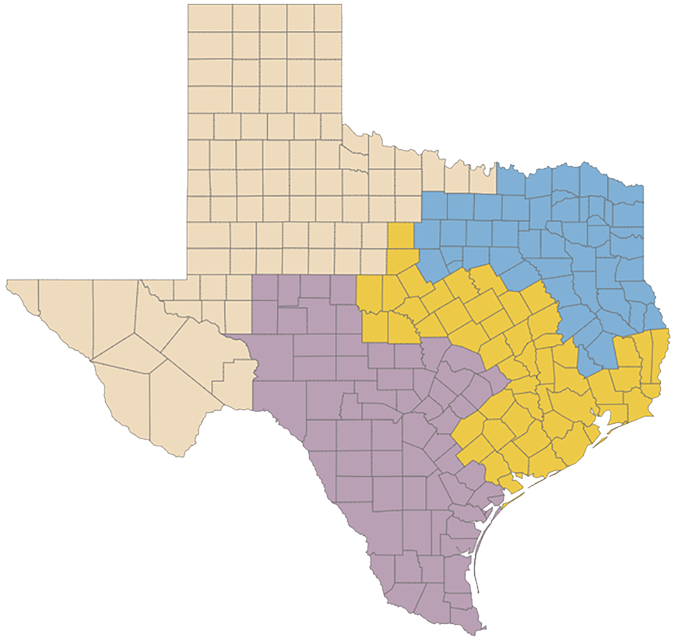
Click the button below for more information on districts and regions.
Frequently asked questions
No, there may be additional items that are considered eligible/ineligible. Contact your RAMP coordinator with specific questions.
Call 1-800-68-PILOT (687-4568) or email AVN_TxDOT_Aviation_Grants@txdot.gov
No, RAMP is an independent program, and funds cannot be used with other TxDOT aviation programs.
No, a resolution is not required.
No, payments must be made to vendors before reimbursement requests can be submitted to TxDOT.
No, reimbursements are not allowed for sponsor payments made to TxDOT.
Please let us know if you have any questions, comments, issues, or concerns: AVN_TxDOT_Aviation_Grants@txdot.gov.