
September 2026
TxDOT pilots digital safety alerts in Austin, Dallas districts
This issue of Emerging Tech Flash explores how connected vehicle technology is bringing roadside warnings directly into the vehicle. Learn how TxDOT's pilot in the Dallas and Austin districts is using digital alerts to give drivers more time to slow down, move over, and safely respond to roadside activity.

Bringing roadside warnings into the vehicle
TxDOT courtesy and patrol operators rely on traditional safety measures such as lights, sirens, and dynamic message signs to alert drivers. While those tools remain essential, operators in the Dallas and Austin areas now have a new way to get motorists' attention.
Drivers in the Dallas and Austin areas may soon notice a new type of in-vehicle safety alert designed to improve safety around roadside operations. TxDOT's Dallas and Austin districts are piloting connected vehicle technology that automatically sends digital alerts through select navigation applications and connected vehicle systems when a TxDOT vehicle's warning lights are activated, advising drivers to slow down and move over in compliance with Texas law.
“When the courtesy patrol operator responds to a stranded motorist or a maintenance worker begins a roadside operation, every passing vehicle presents a safety risk for operators as well as drivers,” said Amanda Miller, P.E, Director of Transportation Operations in TxDOT’s Dallas district. “Digital safety alerts could help reduce that risk.”
Drivers of newer Volkswagen and Stellantis vehicles can receive the alerts through their connected vehicle systems, as well as drivers using Waze or Apple Maps navigation applications.
By providing real-time alerts directly to the driver, TxDOT aims to increase situational awareness and give drivers time to comply with Texas’ Move Over or Slow Down law, which requires drivers to change lanes or slow down to 20 miles per hour below the speed limit when they encounter a stopped vehicle with flashing lights activated. This law applies to TxDOT vehicles as well as law enforcement, utility vehicles, and emergency responders with flashing lights.
“The goal is simple,” said Gabriela Perales, P.E., Traffic Management Systems Supervisor in TxDOT’s Austin District. “Give drivers more time to slow down, move over, and safely react to roadside activity.”
The pilot includes Dallas District’s Bridge Maintenance and Heavy Equipment crew, maintenance vehicles from the Ellis County and Navarro County Maintenance Offices, Dallas County Sheriff's Office (DCSO) Courtesy Patrol vehicles in the Dallas District, and Highway Emergency Response Operator (HERO) trucks in the Austin District. Equipment installation has been completed on all vehicles in the pilot.
"I know that whenever one of my crew hits the emergency lights on the vehicle, it's going to send an alert to other drivers," said Joey Campbell, who manages TxDOT's HERO program in the Austin district. "That's another layer of safety while we're doing our jobs."
During the pilot, TxDOT will track both frequency and volume of alerts as well as changes in driver behavior after receiving the alert. A successful pilot will lead to further deployment across the state for TxDOT fleet vehicles and safety patrols.
"This technology not only helps keep roadside workers safe," said George Villarreal, Director of TxDOT’s Traffic Safety Division. "It will help TxDOT learn whether digital alerting technologies can support future statewide transportation safety and mobility efforts."

TxDOT's 2026 Innovator of the Year
Enad Mahmoud, TxDOT's 2026 Innovator of the Year, is using machine learning and automation to make materials testing at TxDOT more efficient. By leveraging 20 years of historical data and automating the soundness testing process, his innovation reduces testing time from weeks to less than a day, improving efficiency and helping staff work smarter.
Learn more about Enad Mahmoud's innovation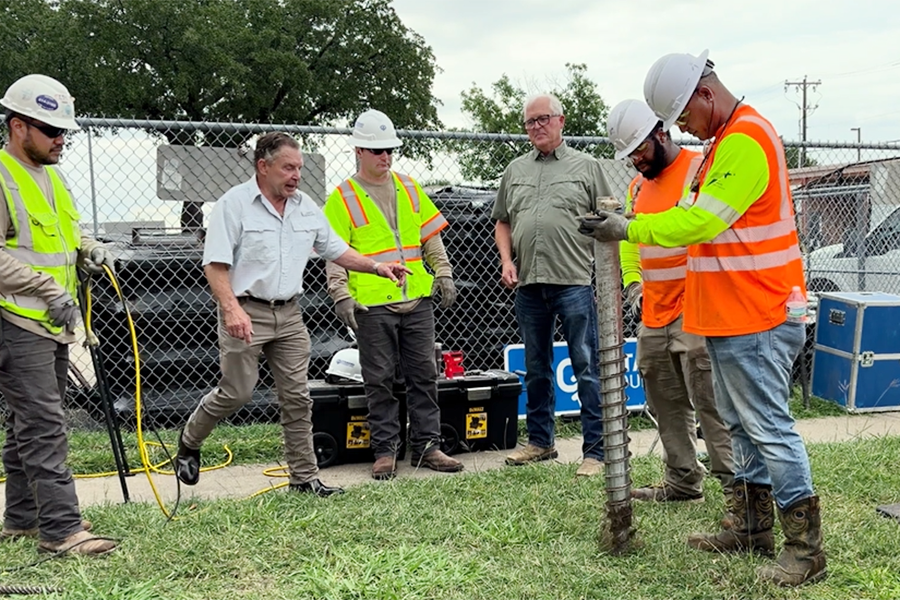
Emerging tech in the districts
The Wichita Falls District has used a type of rapid-installation sign stub known as a ground screw for more than a year. The benefits include improved staff safety and efficient installation.
"Using this system has saved me a lot of work and time not having to wait on a skid steer, a truck and a trailer and making multiple trips and involving extra people to set a sign stub," said Cole Alexander, transportation maintenance technician in TxDOT's Wichita Falls District in Vernon, Texas.
TxDOT staff from the Dallas District recently demoed a ground screw and are considering using the new technology.
Innovation snapshot
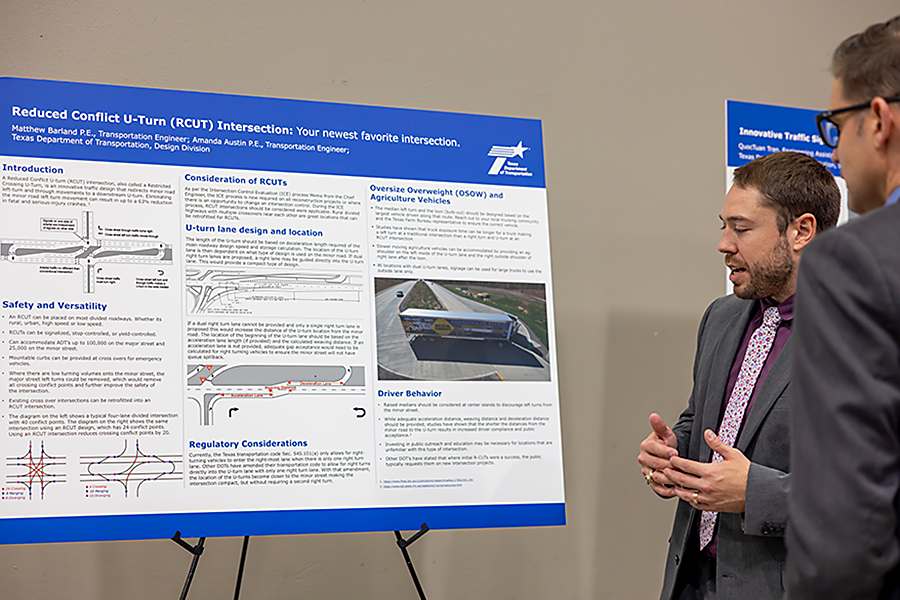
Reduced Conflict U-Turn (RCUT) Intersection
Matthew Barland, P.E., of TxDOT, explains the benefits and design considerations of Reduced Conflict U-Turn (RCUT) intersections, an innovative intersection treatment that improves safety and traffic operations by reducing the number of crossing conflict points. Instead of allowing direct left turns and through movements from side streets, RCUTs route drivers through a series of right turns and U-turns, resulting in fewer opportunities for severe crashes.
Learn more about RCUTs
Technology Teletype
Data Governance: The World's Least Exciting Name for Something Incredibly Important
In this edition of Technology Teletype, Robert Brydia, Technologies Integration Lead with the Texas A&M Transportation Institute (TTI), explores why data governance may be one of the most important, yet least discussed, foundations of a modern transportation agency.
Read Tech Teletype
Mark your calendars
Upcoming meetings
- Sept. 16, 2026
- Sept. 21, 2026
Texas Technology Task Force and CAV Task Force
- Dec. 3, 2026