Data team hunts highway flaws
April 28, 2026
By Tila Grant
DALLAS — Every year, TxDOT’s Pavement Management and Inspection (PMI) team hits the road — literally — to take a close, data‑driven look at the condition of pavements across Texas.
The PMI team is a small, highly specialized group whose work plays a critical role in statewide transportation planning.
Using advanced technology and a limited fleet of specialized equipment, the team collects pavement data across thousands of miles of roadway to support decisions about maintenance, rehabilitation and future construction.
This information directly influences planning and funding decisions, so accuracy, consistency and safety are essential.
“Most drivers probably do not think about what goes into maintaining a smooth roadway, but these inspections are an important part of that process. They help us track pavement conditions and make informed decisions that support safer, more reliable travel,” said Miles Hicks, Transportation Specialist.
A safer, smarter way to collect data
Over the years, TxDOT has modernized how pavement data is collected. Automated pavement data collection has significantly improved safety by reducing the need for workers to be physically present in active traffic lanes during inspections.
In addition, the collection process now includes right‑of‑way and pavement surface imagery, providing visual confirmation of measurement locations and areas of concern. These images allow engineers and analysts to validate findings and better understand roadway conditions.
The equipment behind the numbers
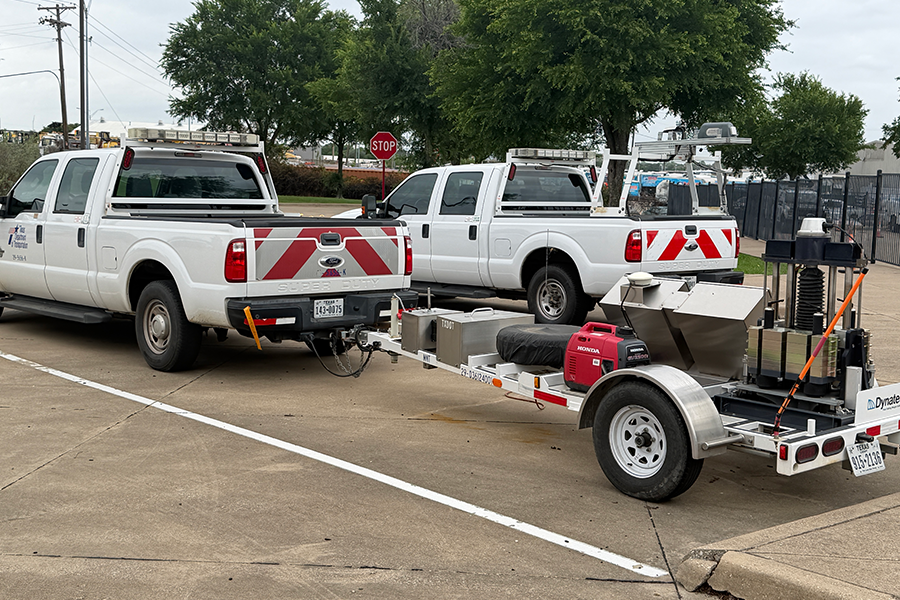
To evaluate pavement conditions, PMI relies on several specialized tools, each designed to measure a different aspect of roadway performance.
Ground‑penetrating radar allows the team to see below the pavement surface and identify structural concerns. GPS technology ensures every data point is precisely located and consistently mapped. Profilers measure ride quality and smoothness from the driver’s perspective, while skid trucks evaluate surface friction—especially under wet conditions. The falling weight deflectometer (FWD) measures pavement strength and structural capacity.
Together, these tools provide a detailed picture of how Texas roads are performing by delivering information more quickly, safely and accurately than ever before.
Turning measurements into meaningful scores
Once data collection is complete, the PMI team analyzes a wide range of pavement distress indicators, including ride quality, rutting, cracking, corner breaks, punch‑outs, and patching on both asphalt and concrete pavements.
These measurements are combined into a single, standardized pavement condition score. Using one consistent score allows TxDOT to compare roadway conditions across the state and prioritize projects where improvements are most needed.
Quality control and why it matters
Statewide pavement data collection usually wraps up in the spring. From there, the information undergoes a thorough review and validation process.
This quality control step is critical to making sure the information used in planning decisions is accurate, reliable and consistent statewide.
PMI’s work forms the foundation of TxDOT’s pavement planning efforts. Last year, TxDOT received a score of 90. A pavement condition score of 90 or above reflects excellent roadway conditions, smooth ride quality, minimal distress and little to no rutting, an important benchmark TxDOT works to maintain across Texas.
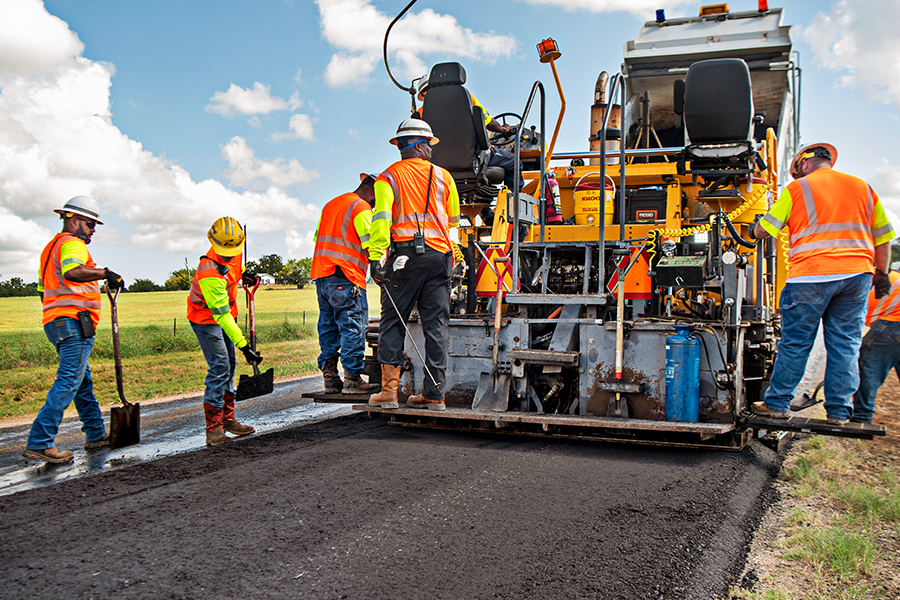
If scores begin to decline, the data helps guide proactive solutions through TxDOT’s four‑year plan, including maintenance contracts, overlays, and rehabilitation projects.