Travel Information Centers: 90 years of welcoming visitors
July 21, 2026
By Lois Rodriguez
AUSTIN — With summer travel season fully underway, the Texas Department of Transportation’s (TxDOT) Travel Information Centers (TICs) are continuing a tradition of hospitality that began with the Texas Centennial nearly a century ago.
World Cup travelers got a chance to share their country pride this summer as TICs helped welcome them with soccer themed selfie stations. It’s a sense of welcoming that’s now nearly a century old as these iconic roadside attractions celebrated their 90-year anniversary.
For 90 years, Texas TICs have served as gateways to the Lone Star State — places where travelers can rest, gather information and discover countless experiences awaiting them. What began as a handful of small information stations handing out water from a barrel, has grown into a statewide network offering an essential service.
The 12 TICs, operated by TxDOT primarily at entry points along the state's border, trace their origins back to 1936, when the state prepared for visitors attending the Texas Centennial celebration and the Texas State Fair. To assist those travelers, the state opened roadside information stations, where visitors could ask questions and receive maps and recommendations for exploring the state.
The success of those efforts — and the unmatched hospitality of friendly travel experts — laid the foundation for what would become a legacy of hospitality.
Then and now
“For generations, Travel Information Centers have been where Texas begins for so many visitors,” said TIC Branch Manager Crystal Fetterolf. “Our travel counselors are often the first friendly face travelers meet, offering a welcoming presence, listening, helping and turning a stop along the road into a memorable and meaningful part of their journey through Texas.”
Nearly 1.5 million people stop at the centers each year. They represent a wide range of travelers including families on vacation, long-distance drivers, truckers, retirees, international tourists and people simply passing through Texas.
Longtime Wichita Falls Travel Information Counselor Tracy Sult said the TICs have the power to set the stage for a positive and lasting encounter.
“The hospitality we offer has a real impact,” she said. “It sets the tone for a traveler’s entire visit and creates a positive impression of our state. A warm greeting, clear guidance, and a willingness to help can completely change someone’s travel experience.”
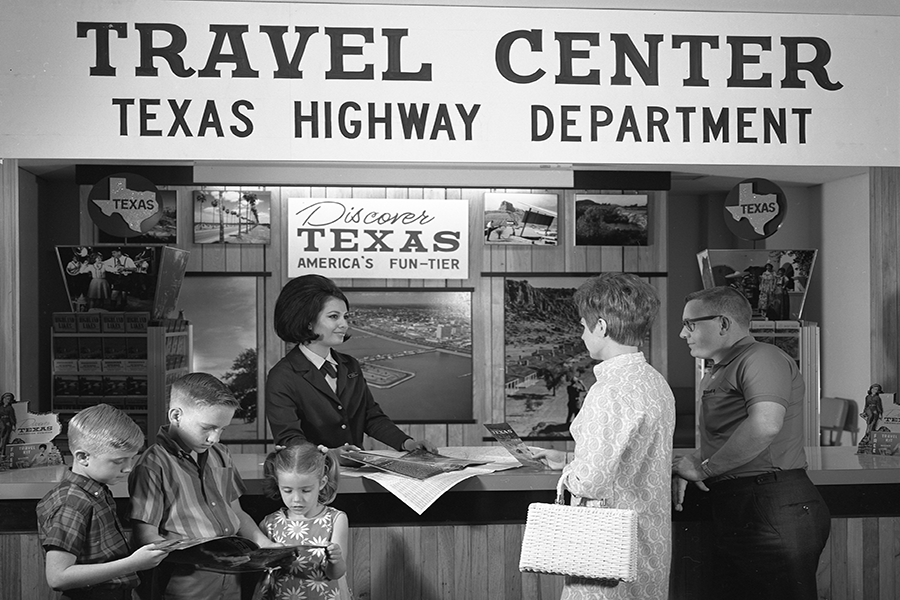
Long before digital navigation, maps were the backbone of travel in Texas. The Texas Highway Department—as TxDOT was known initially—created its first highways map in 1917, and by 1936, those maps were widely distributed to the public at the state’s first travel information stations.
Those early stations were modest, often one-room buildings staffed by Texas A&M cadets who greeted travelers as they entered the state. Visitors were handed free highway maps, given directions and road condition updates, and offered a simple but meaningful Texas welcome, sometimes accompanied by a cup of water from a nearby barrel.
The building designs reflected the regional architecture: log cabins in East Texas, Colonial-style structures in Northeast Texas, and stucco-coated adobe in West Texas.
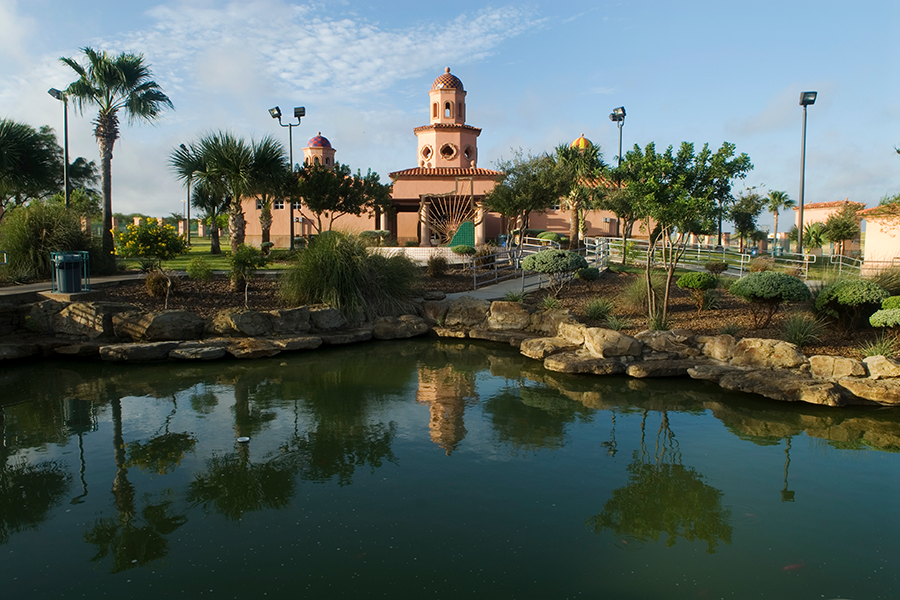
As early information stations were designed to reflect their surroundings, the modern centers also offer that same sense of space. From the canyon-inspired design in Amarillo to the mission-style architecture in Laredo, the historic setting in Langtry, and the wetlands boardwalk in Orange, these centers offer information and a sense of the local vibe.
Over the decades, Texas has continued to expand its commitment to travelers. By the mid-20th century, the state developed an extensive system of roadside parks, scenic turnouts and early rest areas once referred to as “comfort stations.”
As Texas’ highway system grew, visitors gained more than roadside stops. By 1957, visitors could step inside the tourist bureaus to browse brochures, speak with counselors and have access to clean restrooms.
“Visitors are impressed by the story of Texas,” said Mary Ulrich Jackson, a veteran travel counselor stationed at the Austin Travel Information Center, which is located on the Capitol grounds. “From Goliad to the Alamo to San Jacinto, it’s a big story. And then I realize I’m telling the same story over a counter in 2026 that was originally told in a cabin in an outback, a mission, or a fort, or by soldiers around a campfire.”
At the Orange Travel Information Center located along the Texas-Louisiana border, lead counselor Laura Allen said the TICs are selling the Texas experience.
“Our goal is to enhance or elevate a traveler’s visit to Texas,” she said. “It’s Texas hospitality backed with knowledge. One without the other leaves an incomplete experience.”
In 2025, Texas TICs generated an estimated $114.8 million in visitor spending, yielding $7.2 million in state tax revenue and supporting 867 jobs.
Even in the age of smartphones, travelers still value the classic support staples first offered in 1936 — a physical map and the expertise of a travel counselor who can highlight routes, tailor recommendations and help keep them safe for the journey ahead.