36A North
Alternative methodology and process
The identification, consideration and analysis of alternatives are key to the NEPA process and goal of objective decision making. The proposed 36A North is needed due to:
- Address anticipated mobility/congestion issues;
- Improve north/south freight movement;
- Improve north/south linkage/connectivity; and
- Improve safety concerns (crashes and evacuation).
Consideration of alternatives leads to a solution that satisfies the transportation need, and minimizes effects to environmental and community resources. A draft Purpose and Need statement is currently in preparation. The Council on Environmental Quality (CEQ) refers to the alternative's analysis section as the heart of the EIS and requires agencies to:
- Rigorously explore and objectively evaluate all reasonable alternatives, and for alternative which were eliminated from detailed study, briefly discuss the reasons for having been eliminated.
- Devote substantial treatment to each alternative considered in detail including the proposed action so that reviewers may evaluate their comparative merits.
- Include reasonable alternatives not within the jurisdiction of the lead agency.
- Include the alternative of no action.
- Identify the agency’s preferred alternative or alternatives, if one or more exists, in the draft statement and identify such alternative in the final statement unless another law prohibits the expression of such a preference.
- Include appropriate mitigation measures not already included in the proposed action or alternatives.

TxDOT is currently developing a draft Alternatives Methodology for 36A North, which will be made available to the public for comment and summarized in the project EIS.
Screening process
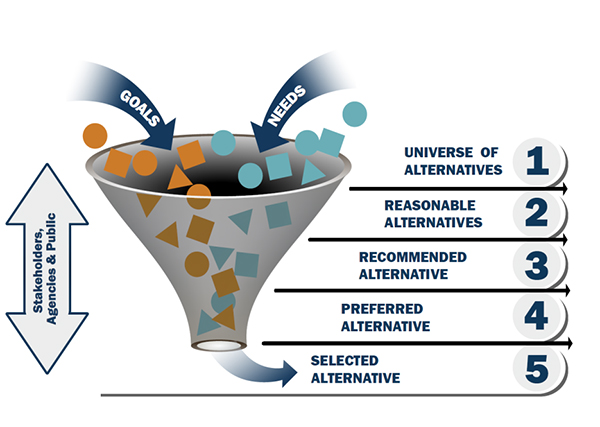
The process to screen, evaluate and decide on alternatives consists of multiple phases.
- Modal Analysis and Universe of Alternatives
Identification and Evaluation of Universe of Alternatives (Level 1 Screening): A range of transportation modes and concepts will be identified and evaluated, and the Universe of Alternatives investigated within the study area that at a qualitative level with an emphasis on avoiding identified constraints. The Universe of Alternatives will be evaluating information gathered from public and agency scoping, constraints mapping, previous studies and best professional judgment from the project design team. Per the Council of Environmental Quality guidelines, evaluating the Universe of Alternatives will bring forward Reasonable Alternatives for the proposed action and help to identify reasons other alternatives were eliminated from detailed study. The Universe of Alternatives and Reasonable Alternatives will be presented at a series of public and agency meetings to gather input and identify other alternatives that may also meet the project purpose and need that the project team had not yet identified, as well as other constraints that may apply to the evaluation.
Scoping Meeting(s): The Scoping Meeting(s) will present the Purpose and Need assessment, a preliminary description of the proposed action and alternatives the EIS will consider, a summary of expected impacts, anticipated permits and other authorizations, a Schedule and Draft Project Coordination Plan and with Draft Appendix Public Involvement Plan.
- Evaluation of Reasonable Alternatives
Evaluation of Reasonable Alternatives (Level 2 Screening): Based on stakeholder feedback at the public meetings, engineering performance, and potential impacts, additional engineering and environmental data will be gathered and evaluated for the Reasonable Alternatives. These alternatives will be evaluated at an equal level of detail in a quantitative analysis, which will also be presented at a series of public and resource agency meetings.
- Evaluation of Recommended Alternative
Evaluation of the Recommended Alternative (Level 3 Screening): A Recommended Alternative will be identified by considering stakeholder input following the public meetings. Additional engineering design or environmental studies may be needed to respond to stakeholder concerns or comments. The Recommended Alternative will be presented at a series of public meetings.
- Selection of Preferred Alternative
Draft Environmental Impact Statement: The DEIS and the Preferred Alternative will be presented at a series of Public Hearings. Because the proposed project aims to culminate with a combined FEIS/ROD, the DEIS will identify the Preferred Alternative. The DEIS and supporting technical reports will document the alternatives analysis process and the Recommended Alternative and identify the Preferred Alternative.
- Decision of Selected Alternative
Final Environmental Impact Statement/Record of Decision: Based on input from the DEIS, technical reports and public hearings, the FEIS/ROD will identify the Selected Alternative from the range of alternatives presented in the DEIS.