Section 5: Other Interconnected Devices
Train Blank-Out Signs for Pedestrians
Pedestrian blank-out signs may be installed along sidewalk approaches as supplementary warning devices to the highway-related active traffic control devices to improve pedestrian safety. Pedestrian blank-out signs can be effective measures at grade crossings with high pedestrian volumes, high train speeds or frequency, extremely wide crossings, complex highway-rail crossing geometry, school zones, inadequate sight distance, and/or multiple railroad tracks. These blank-out signs should be placed such that they are clearly visible to pedestrians along the sidewalk approaches while not intruding into users’ path of travel.
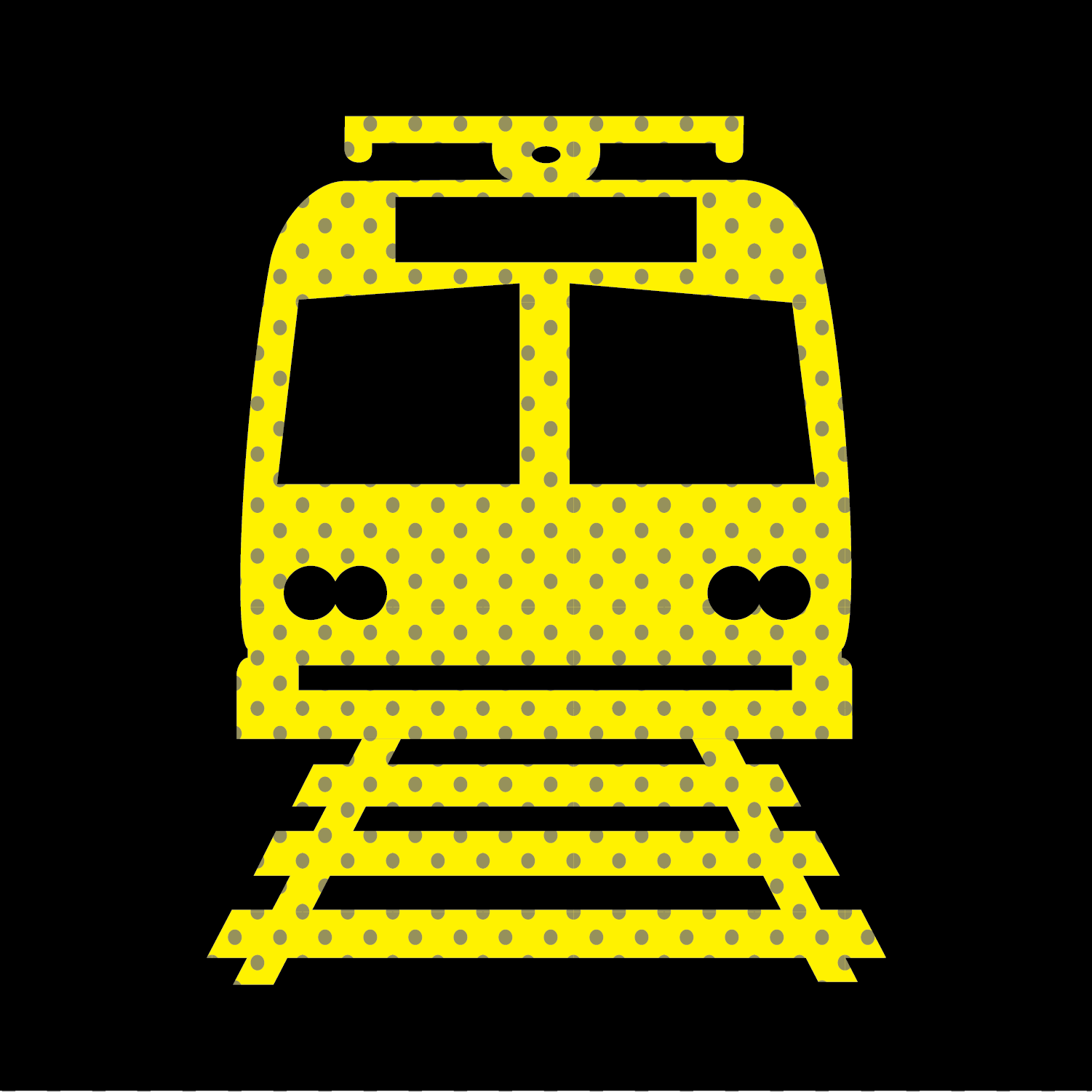
Figure 6–13. W10-7 Blank-out Sign
An example of a blank-out sign that may be used at grade crossings is shown in Figure 6-13, although alternative signs may be selected depending on the intended message to pedestrians. Blank-out signs used to enhance pedestrian safety should be train-activated through an interconnection cable to the railroad signal house similar to an interconnected traffic signal; however, the operation of a blank-out sign is much simpler and may not require a traffic signal controller.
Active Advance Warning Signs
Active advance warning signs (AAWS) shall consist of two 12-inch yellow warning beacons mounted in an assembly with the Advance Warning Sign (W10-1) and activated by detection of an approaching train. The beacons shall be flashed in accordance with TMUTCD Section 4S.01. AAWSs may be supplemented with a message, either active or passive, that indicates the purpose of the device, such as “PREPARE TO STOP WHEN FLASHING”. If used, the AAWS shall remain activated until preemption is complete. AAWS shall operate in a fail-safe mode and default to flashing in the event of an interconnection failure.
A train-activated AAWS should be considered at crossing locations where the railroad signals cannot be seen until an approaching motorist has passed the decision point, which is the distance from the crossing from which a safe stop can be made. The design of an AAWS should include a request for advance preemption or simultaneous preemption as determined by the Diagnostic Team. If advance preemption is used, the advance preemption time should be equivalent to the yellow change time calculated based on the speed of the roadway.
A back-up power supply should be included in case of a power outage or failure. A dysfunctional AAWS cannot alert approaching motorists of the activated railroad signal equipment and could lead to a collision. If a back-up power supply cannot be provided, a passive message such as “RAILROAD SIGNAL AHEAD” may be used to provide a full-time warning message.
The AAWS should be placed at the location where the advance warning sign would normally be placed and should be dependent on vehicle speed and the roadway geometry features. The AAWS may also be cantilevered or installed on both sides of the roadway to enhance motorists’ visibility at grade crossings with unusual geometry or site conditions.