Railroad Relays
Traffic signal interconnection begins at the traffic signal cabinet with an output to the railroad signal house. Railroads use relays in a normally-closed (energized) or normally-open (deenergized) state to complete the circuit back the traffic controller.
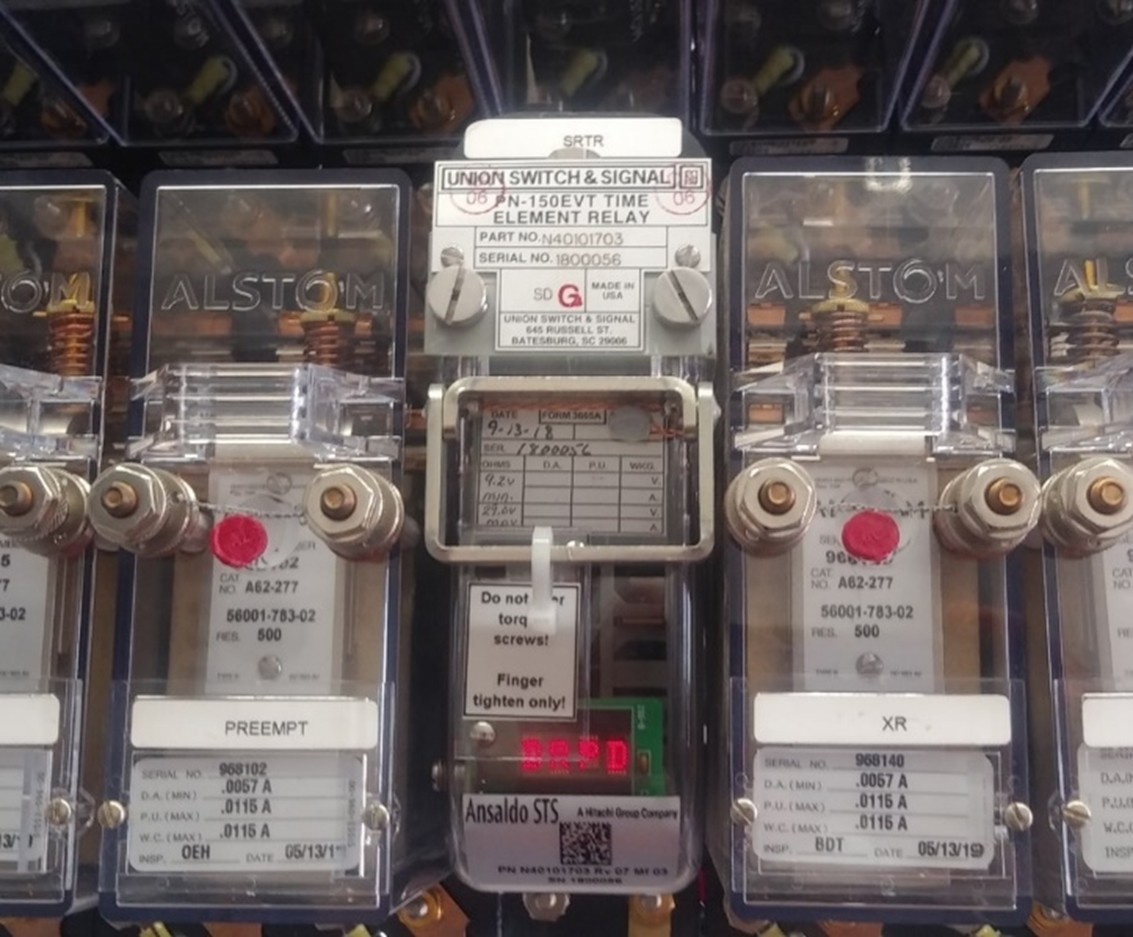
Figure 4–2. Railroad Relays
There are various railroad relays recommended by ITE and AREMA that the railroad may install to provide additional assistance in transitioning from normal to preemption operations. While not every relay is necessary for a successful and safe interconnected grade crossing, TxDOT recommends requesting them as they can transmit important information to the traffic signal controller, which can then respond more efficiently and reliably. Some railroad authorities also require certain relays to be installed alongside any new or modified interconnected grade crossings. These relays and their functions are outlined in Table 4-1 below.
Term | Abbreviation | Function |
|---|---|---|
Advance Pedestrian Preemption | APP | The advance pedestrian preemption relay is typically in a normally closed state. When activated, it notifies the traffic signal controller to finish serving pedestrian clearance on any active pedestrian phase (if applicable) prior to the start of the Preemption Clearance Interval for traffic signal modification projects or new installations. The advance pedestrian preemption relay shall be included where railroad interconnect and pedestrian clearance are needed and the track approach time (TAT) would otherwise violate the AREMA 50‑Second Rule (as defined in Section 5‑4). |
Advance Preemption / Traffic Control Relay | ADV/TCR | The advance preemption relay is in a normally closed state. When activated, it notifies the traffic signal controller to begin preemption operations and begin right‑of‑way transfer. The advance preemption relay shall be included at all interconnected traffic signals as they are modified, or as new signals are installed, unless the diagnostic team determines that simultaneous preemption is most appropriate. |
Crossing Active | XR | The crossing active relay is in a normally closed state. This relay acts as a re-start circuit for trains that are stopped within the approach where the full advance preemption time is not available. When activated, this relay notifies the traffic controller to immediately enter a special truncated preemption program to enter the Preemption Clearance Interval. Railroad warning equipment activates—flashers begin flashing and gates begin descending at the grade crossing. This circuit is often used to activate blank‑out signs during preemption. The crossing active circuit shall be included at all interconnected traffic signals as they are modified, or as new signals are installed. At locations without gates, this circuit should be used to terminate the Preemption Clearance Interval. |
Gate Down | GD | The gate down relay is in a normally open state. When activated, it notifies the traffic signal controller that the gates have descended to a nearly horizontal position, confirming that vehicles are physically restricted from entering the grade crossing area. Once the gates are down, the traffic signal must finish clearing vehicles that have already entered the crossing area. Upon serving any remaining Preemption Clearance Interval, the traffic signal controller terminates the interval and begins limited service operations. The gate down circuit shall be included at all interconnected traffic signals with railroad gates as they are modified or as new signals are installed to prevent a preemption trap. |
Island | ISLD/ISLR | The island relay is in a normally closed state. When activated, it notifies the traffic signal controller that the train has reached the grade crossing. Consequently, this circuit should only be used as a fail‑safe for the gate down circuit. It provides information for the traffic signal to transition to limited service operations. |
Supervision (Supervised) | SUPR | A supervised circuit is normally in the opposite state from the circuit it is supervising to monitor the interconnection between the railroad equipment and the traffic signal. If the connection is broken, the traffic signal shall begin preemption and enter a fault condition. The fault condition should be flashing red. The advance preemption circuit shall be supervised at all interconnected traffic signals as they are modified, or as new signals are installed. |
Traffic Signal Health | HLTH | The traffic signal health circuit notifies the railroad signal system of an unhealthy traffic signal system (for example, flashing‑red operation, power outage). If a problem exists, the railroad signal system can activate the railroad warning equipment sooner in order to safeguard the grade crossing. Traffic signal health shall be included at all interconnected traffic signals as they are modified, or as new signals are installed. |