Section 1: Gathering Relevant Data
This section provides guidance on gathering relevant data to assist in the completion of
. Since every crossing and associated intersection are unique, the physical and operational characteristics of each location can vary significantly. As such, the tools and methodology described herein are to be applied with engineering judgement to arrive at the most appropriate solution.
Collecting relevant data from a variety of sources is the first step in calculating the preemption time. The geometric data of the crossing and associated intersection is a key element in calculating the preemption timing. The Requestor shall measure the following, as defined in TxDOT Form 2304-I:
- Clear Storage Distance (CSD)
- Minimum Track Clearance Distance (MTCD)
- Stop Bar Setback Distance (SBD)
- Width of Receiving Approach (B)
- Offset Distance of Left Turn Stop Bar (OSB)
- Approach Grade
- Angle of Turn at Intersection (Q)
In addition to the geometric data, additional data such as the design vehicle selection, traffic signal timing, and railroad timing are critical information to calculate preemption timing. Figure 3-1 shows how the geometric data is measured at the grade crossing.
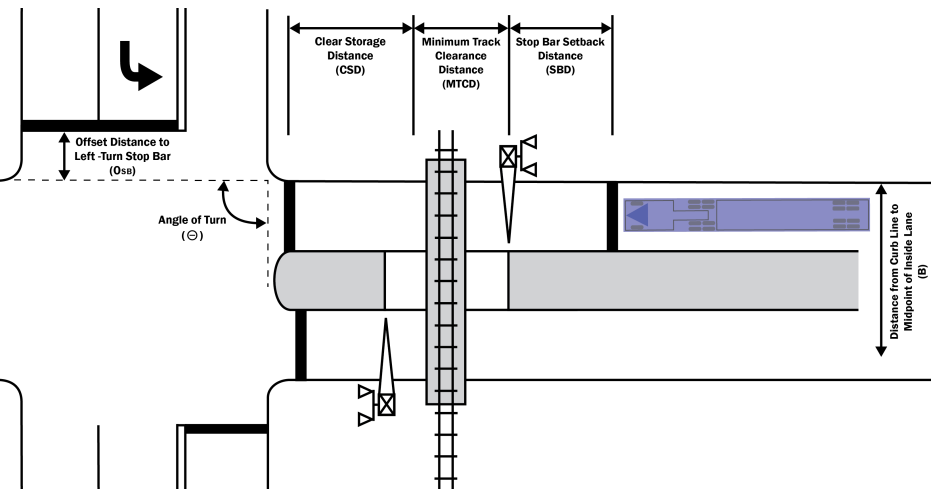
Figure 3–1. Geometric Data at a Grade Crossing
Design Vehicle Selection
The design and operation of the interconnected crossing should reflect the appropriate design vehicle. Typically, the longest vehicle permitted by the Highway Authority should be used as the design vehicle. Table 3-1 (reference from AASHTO’s Policy of Geometric Design of Highways and Streets, 2018) lists the AASHTO designation for potential design vehicle types on TxDOT Form 2304. The TxDOT Form 2304 automatically populates the design vehicle length and centerline turning radius based on the selected vehicle design. TxDOT Form 2304 also allows custom vehicle length to be added for special circumstances.
Design Vehicle Type | Symbol | Length (ft) |
|---|---|---|
School Bus | S-BUS 40 | 40 |
Intermediate Truck | WB-50 | 55 |
Interstate Semi-Truck | WB-67 | 75 |
The Requestor should be aware of which vehicles are allowed at the crossing and associated intersection. Engineering judgement should be applied to determine the most appropriate design vehicle for a crossing as the design vehicle selection is a critical element and may affect certain preemption timing elements including the following:
- Left Turns Towards the Tracks: Due to the difference in vehicle lengths, the time required for left turning vehicles to complete the turn will be affected.
- Queue Clearance Time: The queue clearance interval must be long enough to allow the design vehicle to clear the MTCD. Due to the difference in vehicle lengths, the time required for the design vehicle to start up, move through, and clear the entire MTCD will be affected. This time is also affected by the time required to clear left turns
Traffic Signal Timing
The Requestor shall request all information related to the traffic signal timing from the Highway Authority as it is necessary to determine the Right-of-Way Transfer Time (RWTT) and complete TxDOT Form 2304. If a new traffic signal is being proposed, the proposed times to be programmed to the controller should be provided. The traffic signal timing data shall include, but may not be limited to, the overall cycle length, default minimum times, guaranteed maximum times, track clearance green or Preemption Clearance Interval, signal phasing, and transition during a preemption event, which includes the following (note these times may be different during preemption than the default minimum times, except as noted below):
- Minimum Green Time
- Yellow Change Time (shall not be shortened or omitted)
- Red Clearance Time (shall not be shortened or omitted)
- Pedestrian Walk Time
- Pedestrian Clearance Time
The following parameters are defined by
, AREMA and ITE and used to provide sufficient preemption time to the interconnected traffic signal prior to the arrival of a train at a crossing. The Requestor should understand these parameters when performing preemption calculations and the effect of signal timing on preemption to communicate preemption timing needs to the Railroad Authority.
Right-of-Way Transfer Time (RWTT)
is the amount of time needed prior to display of the track clearance interval. This includes any time needed by the railroad, light rail transit, or highway traffic signal control equipment to react to a preemption call, and any traffic control signal green, pedestrian walk and clearance if used, yellow change, and red clearance intervals for conflicting traffic. Since preemption may occur at any given moment during normal operations, enough time must be provided to safely transition any active phases to the Preemption Clearance Interval. In order to terminate any active phase prior to track clearance green, the minimum green, yellow change, red clearance, and pedestrian clearance intervals must be considered. The RWTT values in TxDOT Form 2304 shall reflect the worst-case scenario.
TxDOT Form 2304-I provides general guidance to assist the Requestor when it may be appropriate to truncate the pedestrian clearance time in the presence of a preemption call at a crossing. Consideration to truncate the pedestrian time includes the following:
- Pedestrian volumes
- Frequency of preemption events
- Vehicle minimum times
- Intersection geometry
- Types of pedestrian users
Limitations in railroad equipment may necessitate partial truncation of pedestrian clearance time at locations where the Highway Authority would otherwise desire full pedestrian clearance time. Details related to how to handle this scenario are discussed further in Chapter 4 of this manual.
Track Clearance Green (TCG)
is the portion of the traffic signal sequence when the RWTT has completed and green signal indications are displayed to roadway users to clear the MTCD. Per TxDOT Form 2304-I, the TCG is the time required to avoid the preempt trap and provide enough time for the design vehicle to clear the portion of the CSD as defined in the calculations. TCG should be equal or exceed the queue clearance time. TCG is the Preemption Clearance Interval (PCI) where a green indication is required to allow vehicles to clear the tracks. Queue Clearance Time (QCT)
is the time required for the Design Vehicle stopped within the minimum track clearance distance to start up, move through and clear the MTCD. If pre-signals are present, this time should be long enough to allow the Design Vehicle to move through the intersection or clear the tracks if there is sufficient CSD. If a four-quadrant gate system is present, this time shall be long enough to permit the exit gate arm to lower after the Design Vehicle is clear of the MTCD. Separation Time
is the component of maximum highway traffic signal preemption time during which the MTCD is clear of vehicular traffic prior to the arrival of the train. Maximum Highway Traffic Signal Preemption Time
is the maximum amount of time needed following the initiation of the preemption sequence for the highway traffic signals to complete the timing of the RWTT, QCT, and Separation Time. Railroad Timing
The Requestor shall collect applicable railroad warning times, existing advance preemption time, train speed, light flashing time before gate descent, gate descent time, buffer time, and railroad equipment response time from the Railroad. The understanding of these times will help the Requestor understand how the grade crossing will operate during a preemption event.
TxDOT Form 2304 automatically calculates the following railroad timing parameters:
- Required Minimum Time (MT): The TxDOT Form provides the least amount of time active warning devices shall operate prior to the arrival of a train at a highway-rail grade crossing. Per TMUTCD, “Flashing-light signals shall operate for at least 20 seconds before the arrival of any rail traffic.”
- Clearance Time (CT): The additional time that may be provided by the railroad to account for longer crossing time at a wide crossing. Per AREMA, “If the MTCD exceeds 35 ft, clearance time is one second for each additional 10 ft., or portion thereof, over 35 ft.”
- Total Minimum Warning Time (MWT): is the sum of the minimum time (MT) and the clearance time (CT).
- Advance Preemption Time (APT): is the period of time that is the difference between the required maximum highway traffic signal preemption time and the activation of the railroad or light rail transit warning devices. This value is calculated by subtracting the total minimum warning time from the maximum preemption time for queue clearance in Form 2304.