Composite Eligibility Ratios (CER)
On any given project, there may be multiple utility adjustments at different locations within the highway right of way project limits. When these different locations contain different line sizes and/or eligibility ratios, it will be necessary to calculate a CER. A CER is calculated to mitigate administrative and accounting difficulties encountered with simultaneous work sites having different individual eligibility ratios. The total cost of the adjustment should include all cost associated with the adjustment including engineering, construction, administration, inspection, etc. When calculating eligibility ratio, counting the length of the pipe and the cable carried within the pipe is not acceptable.
The formula for determining a CER is:
CER= [(X+Y+Z) / (A+B+C)] * 100%
Where:
- A= Total Cost of Adjustment of Utility “A”
- B= Total Cost of Adjustment of Utility “B”
- C= Total Cost of Adjustment of Utility “C”
- X= “A” times the Eligibility Ratio for Utility “A”
- Y= “B” times the Eligibility Ratio for Utility “B”
- Z= “C” times the Eligibility Ratio for Utility “C.”
For example using the scenario shown in Table 8-1 and Figure 8-1:
Facility to be adjusted | Total Cost of Adjustment | Individual Eligibility Ratio | X, Y & Z Factors |
|---|---|---|---|
City Sewer Line – Adjustment A | $300,000 | 30% | X = $90,000 |
City Sanitary Sewer Treatment - Adjustment B | $100,000 | 100% | Y = $100,000 |
City Water Line – Adjustment C | $20,000 | 0% | Z = $0 |
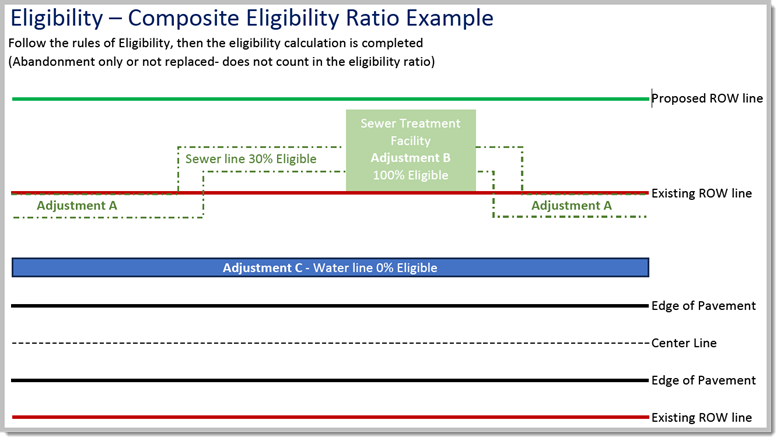
Figure 8-1
. Example Scenario for CER Calculation
CER= [(X+Y+Z) / (A+B+C)] * 100%
= [(90,000 +100,000 + 0) / (300,000 + 100,000 + 20,000)] * 100%
= [190,000/420,000] * 100%
= 0.452381*100%
= 45.24%
Therefore, the CER for this example would be 45.24%.
The burden of proof regarding compensable interest lies with the utility company!
When reviewing and approving the eligibility ratios, the District must consider appropriate affidavits and attachments provided by the utility, in each case which may be supported by (i) applicable laws and codes, (ii) published (internally or otherwise) industry standards or design practices of the utility, and (iii) the sound engineering expertise and judgment of licensed professional engineers which may be demonstrated in the form of a signed and sealed engineering determination letter.