4.7 Seismic Evaluation Tools
Seismic tools can be divided into two groups: those used in the field for evaluation of in situ pavement properties and those used to evaluate samples in the laboratory.
4.7.1 Field Seismic Tools
Portable and Dirt Seismic Pavement Analyzer (PSPA, DSPA)
. The PSPA has an enhanced capability to measure the seismic modulus, delamination, debonding, and thickness of the upper strata (i.e., HMA lift) of the pavement structure. The DSPA is similar in configuration, but has a broader hammer surface for use on unbound surfaces. The foot that contacts the surface is an inactive anvil that is struck with an internal striker; the contact piece acts as a wave transmitter. Specialized acquisition and analysis software is loaded on a laptop computer to retain system portability. 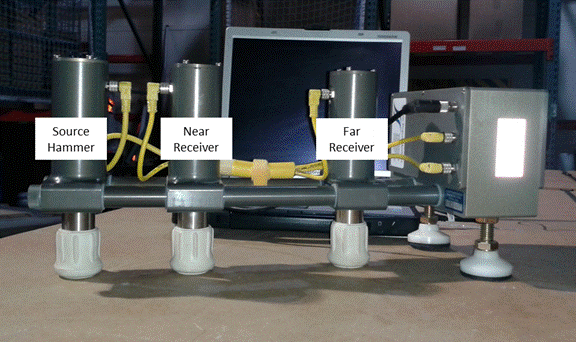
Figure 4-12. Portable Seismic Pavement Analyzer.
4.7.2 Laboratory Seismic Tools
V-meter.
The V-meter is an ultrasonic laboratory device that is particularly useful for testing HMA briquettes (lab-compacted specimens or field cores). In this device, a transmitting transducer is securely placed on the bottom face of the specimen. The transducer is connected to the built-in high-voltage electrical pulse generator of the device. The electric pulse is transformed into a mechanical vibration which is applied to the specimen. A receiving transducer is securely placed on the top face of the specimen, opposite the transmitting transducer. The receiving transducer, which senses the propagating waves, is connected to an internal clock of the device. The clock automatically displays the travel time of compression wave. By dividing the height of the specimen by the travel time, the compression wave velocity and, as such, the seismic
modulus of the material, is determined.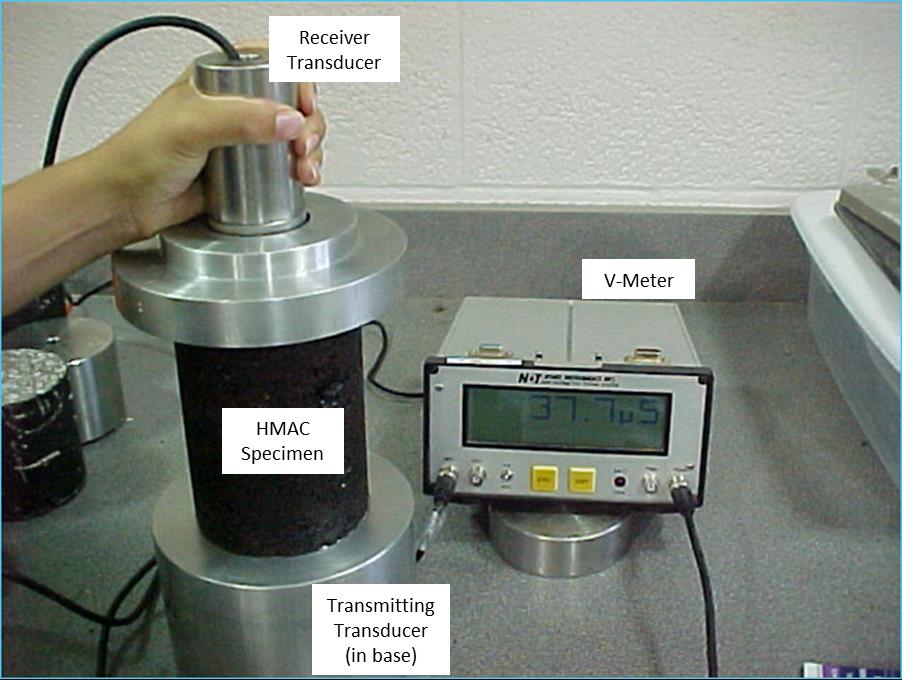
Figure 4-13. V-Meter.
Free-free Resonant Column.
The resonant column device uses laboratory-prepared soil specimens that may be prepared using the Proctor (ASTM D-698), modified Proctor (ASTM D-1557), or any other procedure adopted by the agency. Since the test is non-destructive, a membrane can be placed around the specimen so that the specimen can be tested later for strength (static triaxial test) or stiffness (resilient modulus or cyclic triaxial test). An accelerometer is securely placed on one end of the specimen, and the other end is impacted with a hammer instrumented with a load cell. In less than 3 min., a specimen can be tested, and the test result can be obtained. The process has been automated and simplified so that a technician can perform the test, interpret the results, and generate a report almost immediately.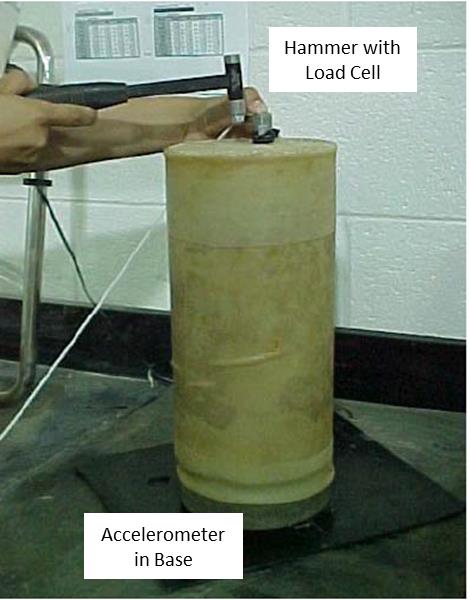
Figure 4-14. Resonant Column.